
An outdoor furniture specification sheet can tell a B2B buyer far more than a product photo or quotation alone.
For importers, wholesalers, retailers, hospitality buyers, sourcing companies and project buyers, learning how to read an outdoor furniture specification sheet makes supplier comparison much more accurate.
Here are 12 details buyers should check before approving a sample or placing a production order.
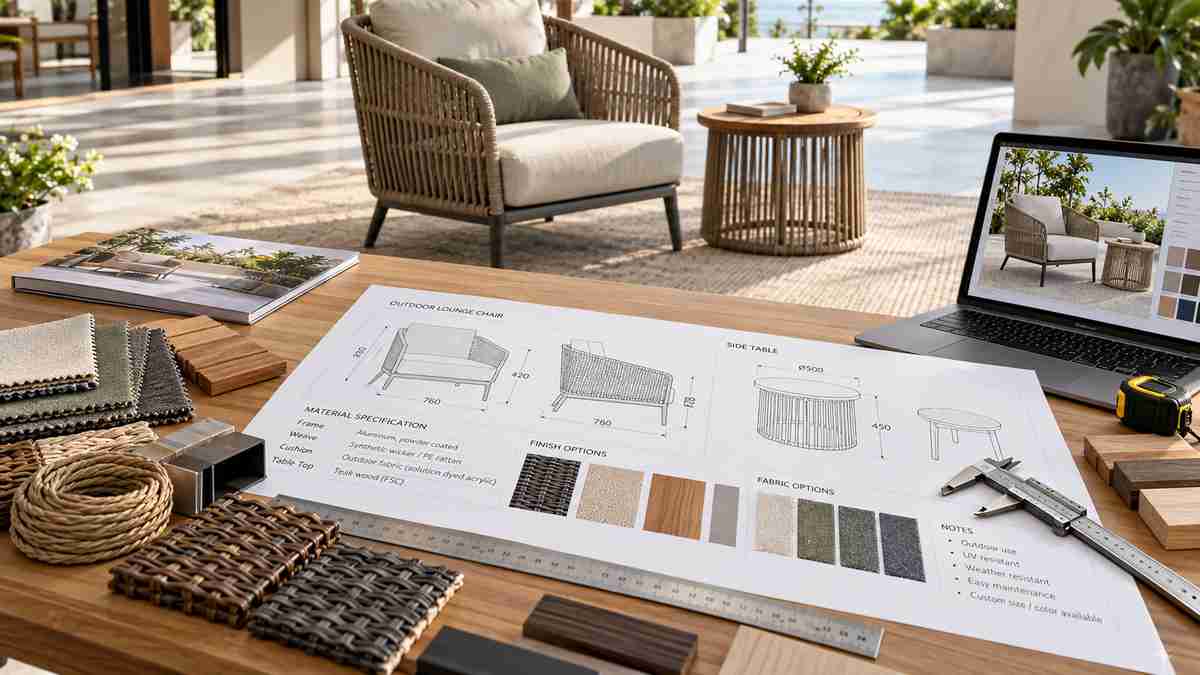
Outdoor Furniture Specification Sheet: Quick Checklist
| Specification Area | What B2B Buyers Should Check |
|---|---|
| Product Identity | SKU, model, version, date and drawing reference |
| Dimensions | Overall size, seat height, seat depth, arm height and tolerances |
| Frame | Material, alloy or grade, tube profile and wall thickness |
| Finish | Color reference, texture, pretreatment and coating requirements |
| Weaving | Material, profile, diameter, color and weaving pattern |
| Cushion | Fabric, GSM, foam, thickness, zipper, piping and construction |
| Wood / Tabletop | Species, dimensions, finish, glass or other tabletop specification |
| Hardware | Screws, bolts, feet, brackets and KD components |
| Construction | Assembly method, joints, welding and structural details |
| Testing | Buyer, market and product-specific requirements |
| Packaging | Carton size, CBM, units/carton, NW/GW and packing method |
| Approval | Golden sample, revision number and QC acceptance criteria |
1. Check Product Identification and Revision
Every outdoor furniture specification sheet should clearly identify the product it controls.
Basic information may include:
- Product name
- SKU or model number
- Collection name
- Drawing number
- Specification version
- Revision date
- Customer reference
Revision control is particularly important during custom development.
A product may change several times between the first quotation and final approval. Dimensions may be adjusted, a rope color may change, cushion thickness may increase or packaging may move from fully assembled to knock-down.
Without a clear revision number, the buyer and factory may unknowingly work from different documents.
2. Review Overall and Functional Dimensions
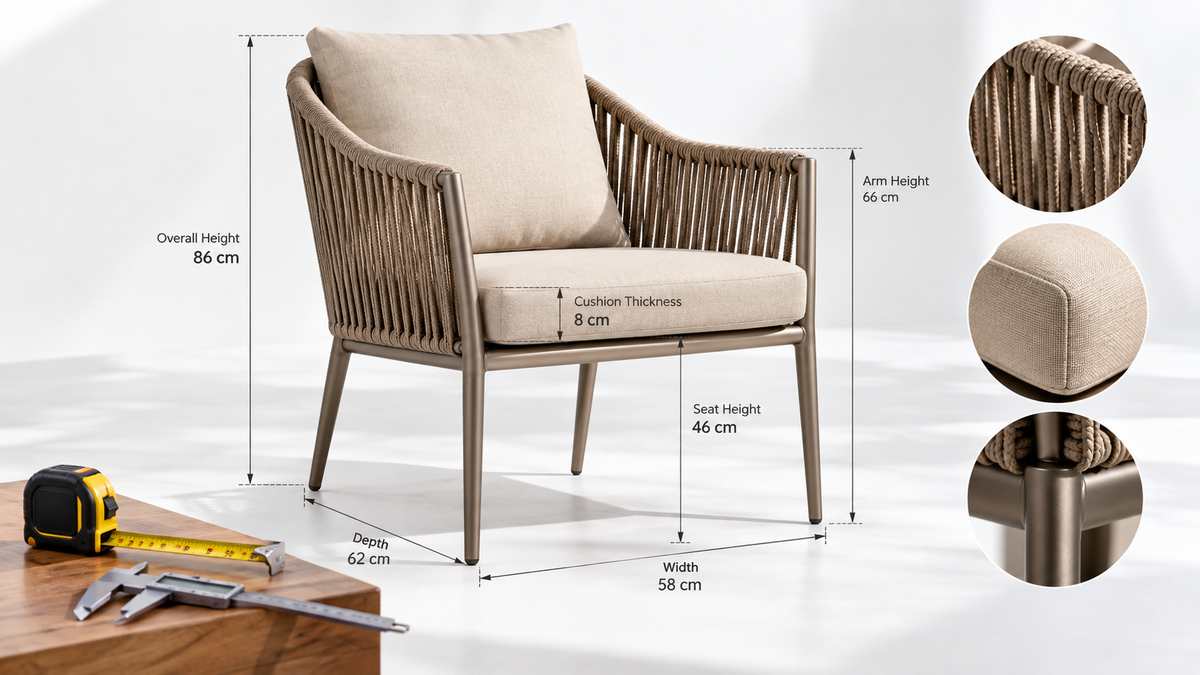
Overall dimensions are among the first details buyers notice, but an outdoor furniture specification sheet should include more than width, depth and height.
For seating products, useful measurements can include:
- Overall width
- Overall depth
- Overall height
- Seat width
- Seat depth
- Seat height
- Armrest height
- Backrest height
- Cushion thickness
A difference of only a few centimeters can noticeably change comfort, table compatibility, carton dimensions or how a product fits into a retail collection.
Dining products require particular attention to the relationship between seat height, arm height and table height.
For sofas and lounge chairs, buyers should also consider seat depth, back angle and cushion compression rather than checking overall dimensions alone.
3. Check Frame Material, Tube Profile and Wall Thickness
The frame section is one of the most important parts of an outdoor furniture specification sheet.
A description such as “aluminum frame” is usually not detailed enough for professional sourcing.
The document may need to specify:
- Frame material
- Relevant alloy or material grade
- Round, square or rectangular tube
- Tube dimensions
- Wall thickness
- Structural reinforcement
- Separate specifications for legs, arms and seat frames
The Aluminum Association explains that different alloying elements affect characteristics including strength, workability and corrosion resistance.
B2B buyers can review the Aluminum Association standards and alloy information for additional technical background.
However, one alloy number or one wall-thickness value should never be judged in isolation. Frame geometry, welding, reinforcement and intended use also affect the final construction.
For a deeper explanation, see Saigon Wicker’s Aluminum Outdoor Furniture B2B Guide.
4. Define Frame Finish and Color Clearly
“Black powder coating” or “beige frame” is not a complete finish specification.
Buyers should define the approved finish as clearly as possible.
The specification may include:
- Color reference
- Pantone, RAL or buyer-specific standard where applicable
- Matt, semi-matt or textured appearance
- Surface pretreatment requirements
- Powder specification
- Approved physical color sample
- Acceptable visual variation
Digital screens should not be the only reference for production color approval because the same color can appear different depending on display settings, lighting, surface texture and material.
A physical approved sample provides a stronger production reference.
5. Specify Rope, Wicker and Textilene Properly
Woven materials can significantly affect both appearance and product cost.
If an outdoor furniture specification sheet simply states “rope” or “rattan,” important manufacturing information is missing.
For rope, buyers may need:
- Material composition
- Round, flat or oval profile
- Diameter or width
- Core construction
- Color reference
- Weaving pattern
- Spacing and tension
For synthetic wicker, the sheet may define profile shape, width, thickness, surface texture, color and approved weaving pattern.
Textilene or sling materials should also include relevant composition, color and physical specification.
See the Outdoor Rope vs PP Rattan guide for a more detailed comparison of these two woven materials.
6. Read the Fabric, Foam and Cushion Specification
Cushions contain several individual components, so “beige cushion” is not enough information for repeatable production.
The specification may identify:
- Fabric composition
- Fabric supplier or article number
- Fabric weight in g/m²
- Approved color
- Foam type
- Foam thickness
- Foam firmness or density where specified
- Fiber or batting
- Zipper
- Piping
- Velcro
- Inner liner
- Drainage construction where required
B2B buyers should approve the complete cushion rather than selecting fabric and foam independently.
For fabric sourcing, see Saigon Wicker’s Olefin vs Polyester Outdoor Fabric guide.
7. Check Wood and Tabletop Specifications
Tables and mixed-material products need their own specification details.
For wooden components, buyers may need to confirm:
- Wood species
- Board or slat dimensions
- Slat spacing
- Surface finish
- Color reference
- Moisture requirements where applicable
- Certification requirements
If FSC-certified material is required, this should be communicated before quotation and production planning.
Learn more from the Forest Stewardship Council.
For glass tabletops, the specification may include:
- Tempered glass requirement
- Glass thickness
- Color
- Painted or transparent finish
- Edge treatment
- Dimensions
Aluminum, ceramic, stone-look or composite tabletops should be documented with the same level of clarity.
8. Do Not Ignore Hardware, Feet and KD Connections
Hardware may account for a small percentage of a product’s visible area, but it can have a major impact on assembly and after-sales complaints.
Check:
- Screw and bolt material
- Dimensions
- Washers
- Brackets
- Adjustable feet
- Foot glides
- Connection plates
- Tools supplied with the product
- Spare hardware requirements
For knock-down furniture, connection points should be shown clearly enough for the supplier, QC team and destination customer to understand how the product is assembled.
9. Confirm Construction and Assembly Details
An outdoor furniture specification sheet should describe how the product is built, not only what materials it contains.
This can include:
- Welding locations
- Reinforcement
- Joint construction
- Seat support
- Backrest support
- Table-leg connection
- KD assembly points
- Drainage holes
- Removable components
Construction becomes particularly important when buyers request changes to an existing model.
A change that appears cosmetic can affect structural geometry, production time, carton size or assembly.
10. Add Testing and Compliance Requirements
Testing should be defined according to the actual product, buyer and destination market.
The specification sheet may therefore reference:
- Required structural testing
- Chemical requirements
- Fabric performance
- Coating requirements
- Buyer-specific test protocols
- Market-specific requirements
- Required documentation
Material certifications should also be connected to the exact material they cover.
For example, OEKO-TEX STANDARD 100 relates to textiles tested for harmful substances. It should not automatically be interpreted as certification of the complete furniture product.
See OEKO-TEX STANDARD 100 and Saigon Wicker’s Certifications page for additional context.
11. Review Packaging, Carton Size and CBM
A complete outdoor furniture specification sheet should not stop at the finished product.
Packaging influences product protection, warehouse handling and logistics cost.
B2B buyers should check:
- Fully assembled or KD packing
- Units per carton
- Carton dimensions
- Net weight
- Gross weight
- CBM per carton
- Internal protection
- Hardware position
- Assembly instructions
- Barcode and carton marking
- Estimated container loading quantity
This information is especially important when comparing quotations.
A lower unit price does not necessarily create a lower landed cost if the packaging configuration uses significantly more container space.
For more detail, read Saigon Wicker’s Outdoor Furniture Packaging for Export guide.

12. Connect the Specification Sheet to the Approved Sample and QC
The final specification should become a control document for mass production.
Ideally, the factory’s QC team should be able to compare production against:
- Approved specification sheet
- Technical drawing
- Approved physical sample
- Approved material samples
- Approved color references
- Packaging specification
- Buyer inspection requirements
Whenever a product changes, the specification should be updated and the revision recorded.
This prevents an old drawing, outdated fabric reference or previous carton configuration from continuing into production.
How Saigon Wicker Uses Product Specifications for B2B Development
Saigon Wicker develops outdoor furniture for international importers, wholesalers, retailers, hospitality buyers and project customers.
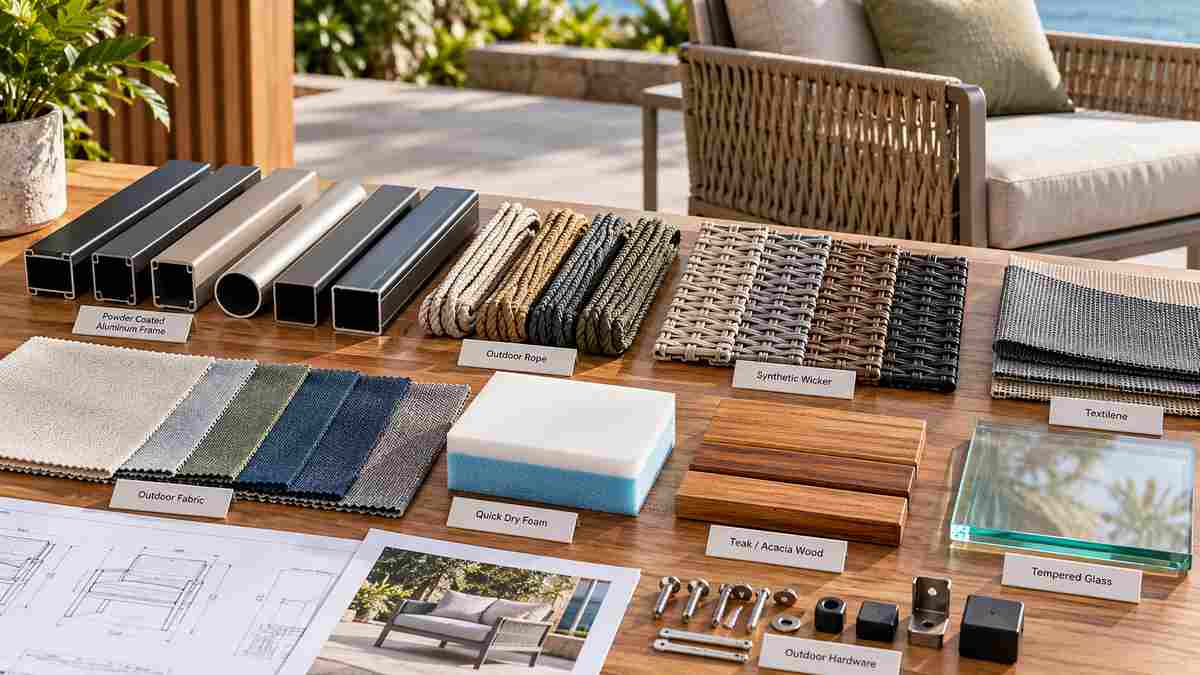
Products can combine powder-coated aluminum, steel, outdoor rope, synthetic wicker, Textilene, wood, tempered glass, outdoor fabrics and cushions.
Because each combination creates different manufacturing requirements, product specifications are important when moving from buyer reference images or drawings into sampling and repeatable production.
Learn more about our Factory & Manufacturing capabilities.
Frequently Asked Questions About Outdoor Furniture Specification Sheets
What is an outdoor furniture specification sheet?
An outdoor furniture specification sheet is a technical document that records important product information such as dimensions, materials, colors, construction, cushions, hardware, testing and packaging requirements.
Why do B2B buyers need a furniture specification sheet?
It gives the buyer and manufacturer a common reference for quotation, sample approval, production and quality control. It also makes quotations easier to compare when multiple suppliers are involved.
What dimensions should be included on a furniture specification sheet?
Depending on the product, buyers may need overall width, depth and height as well as seat height, seat depth, seat width, arm height, tabletop height and cushion thickness.
Should tube wall thickness be included?
For metal furniture, important tube profiles, dimensions and wall thicknesses can be included when they form part of the approved construction. These values should be considered together with frame geometry, reinforcement and welding.
Should packaging information appear on the specification sheet?
Yes. Carton dimensions, units per carton, CBM, net and gross weight, KD or assembled packing and estimated container loading quantity can all influence B2B purchasing decisions.
Is the specification sheet more important than the approved sample?
They serve complementary purposes. The sample provides a physical reference, while the specification sheet records measurable and repeatable product requirements. Professional production control works best when both match.
When should an outdoor furniture specification sheet be finalized?
The document should develop during sampling and be finalized before mass production. Any later approved change should create a controlled revision so production and QC teams are working from the latest version.
Conclusion
An outdoor furniture specification sheet should answer one simple question: exactly what product has the buyer approved?
The answer should cover much more than appearance. Dimensions, frame material, tube construction, surface finish, weaving, cushions, wood, tabletops, hardware, testing, packaging and revision control all contribute to a repeatable product.
For B2B buyers, reviewing these 12 areas before confirming mass production makes quotations easier to compare and gives both the buyer and manufacturer a clearer reference for sampling and quality control.
Send Your Outdoor Furniture Specification to Saigon Wicker
Developing a new outdoor furniture collection, OEM/ODM product or hospitality project?
Send us your drawings, reference images, dimensions, material requirements, colors, target quantities, packaging requirements and destination market. Our team can review the specification before sampling and quotation.
Contact Saigon Wicker for B2B product development and quotation →