
However, two pieces of aluminum outdoor furniture that look similar in a showroom can perform very differently in production, shipping, and long-term use.
The difference often lies in details B2B buyers cannot evaluate from a product photo alone: alloy selection, tube dimensions, wall thickness, welding, drainage, surface preparation, powder coating, hardware, structural design, quality control, and packaging.
This guide explains 10 areas buyers should review before placing an order for aluminum outdoor furniture.
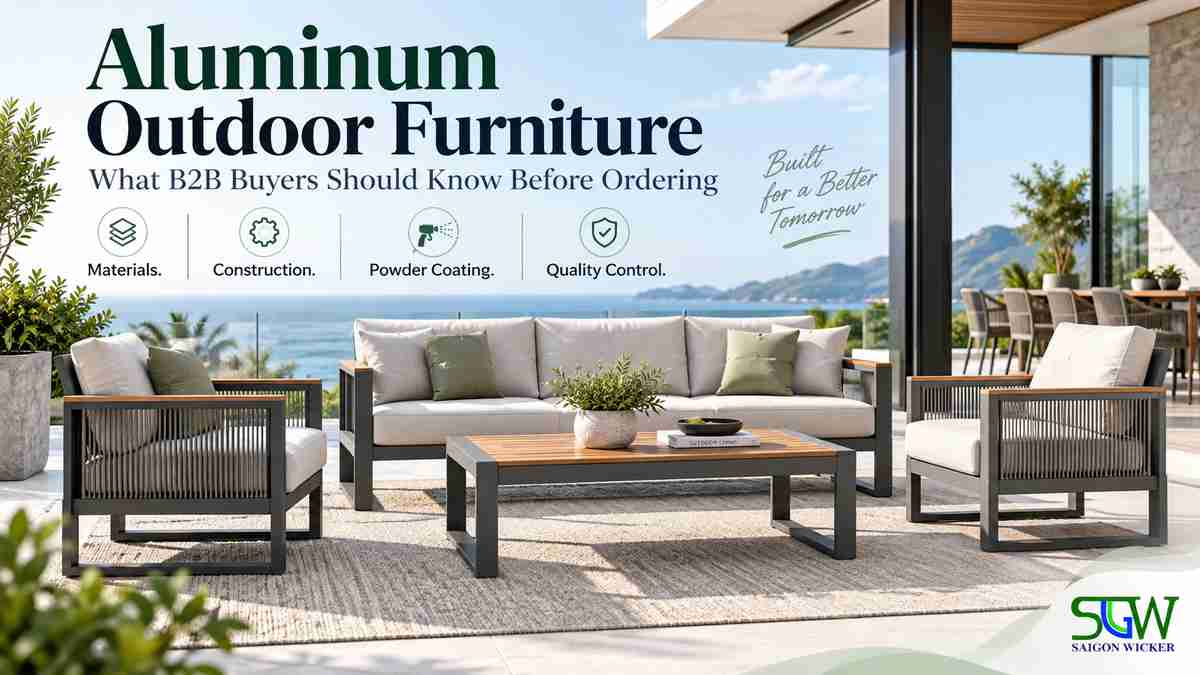
Why Is Aluminum Widely Used for Outdoor Furniture?
Aluminum combines several characteristics that make it practical for outdoor furniture manufacturing.
It is relatively lightweight, can be formed into different profiles, can be welded into furniture frames, and can accept protective and decorative surface finishes such as powder coating.
Different aluminum alloys have different mechanical and corrosion characteristics, which is why professional buyers should avoid evaluating every aluminum frame as if it were the same material.
The
Aluminum Association
explains that alloying elements influence properties such as strength, workability and corrosion resistance.
This means the right question is not simply:
“Is this furniture aluminum?”
A more useful B2B question is:
“What aluminum specification, frame construction, coating system and quality standard are being used for this product?”
1. Ask What Aluminum Alloy Is Being Used
The first technical question buyers should ask concerns the aluminum itself.
Aluminum is not one single material specification. Different alloys are developed for different combinations of formability, strength, weldability, corrosion performance, and manufacturing methods.
For aluminum outdoor furniture, buyers should ask the supplier to state the material specification used for the main frame and important structural components.
Do not assume that a particular alloy number automatically guarantees a high-quality finished chair or sofa.
The final product also depends on:
- Tube dimensions
- Wall thickness
- Frame geometry
- Welding quality
- Reinforcement
- Surface preparation
- Coating system
- Assembly
For B2B sourcing, the approved technical specification should identify the relevant materials clearly enough that the factory can reproduce the product consistently in repeat orders.
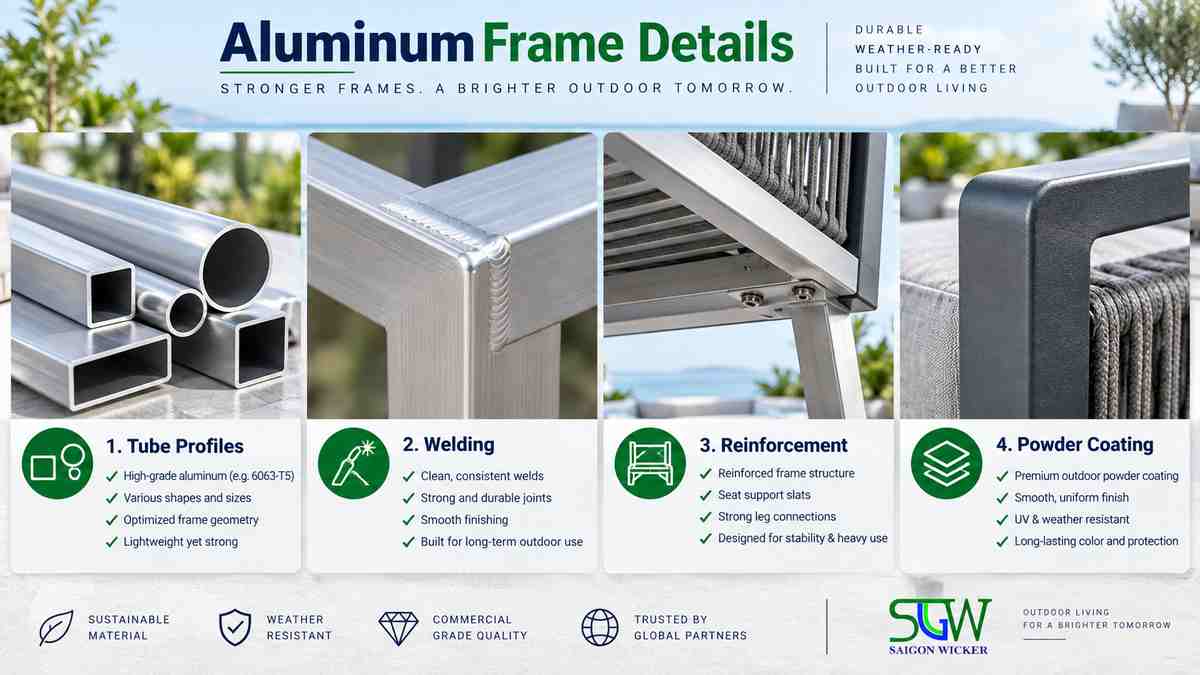
2. Check Tube Dimensions and Wall Thickness
Tube specification is one of the areas that cannot be judged reliably from a lifestyle image.
Two frames may appear visually identical while using different tube profiles or wall thicknesses.
Buyers should ask for information such as:
- Round, square, rectangular, or custom tube profile
- External tube dimensions
- Wall thickness
- Location of structural reinforcement
- Tube specification for legs, arms, seat frames, and backrests
Wall thickness should not be evaluated as a single isolated number.
A larger number does not automatically create a better product if the frame design, welding, weight distribution, or structural geometry is poor.
A capable aluminum outdoor furniture manufacturer should evaluate tube specifications as part of the complete frame design.
3. Review Frame Construction and Reinforcement
Structural design is especially important for seating products.
A dining chair, deep lounge sofa, sun lounger, bar chair, and modular corner unit all carry loads differently.
Buyers should understand how the main frame is constructed and where reinforcement is required.
Areas worth checking include:
- Seat-frame support
- Leg connections
- Armrest connections
- Backrest support
- Table-leg connections
- Corner joints
- Support bars
- KD connection points
Unnecessary metal can increase cost and weight, while insufficient structure can affect stability.
The objective is an efficient structure that supports the intended use of the product.
4. Inspect Welding Quality
Welding is one of the clearest indicators of manufacturing consistency in aluminum outdoor furniture.
Welds should be evaluated for both structural function and visible finish.
Depending on the design, buyers may check:
- Weld continuity
- Position of welds
- Excessive grinding
- Sharp edges
- Visible gaps
- Frame distortion
- Alignment after welding
- Appearance of exposed joints
Grinding should create the required final appearance without unnecessarily weakening the joint or creating inconsistent surfaces.
Sample approval should establish the acceptable visual standard before mass production begins.
5. Check Drainage and Outdoor Frame Design
Outdoor furniture is exposed to rain, cleaning water, humidity, and temperature changes.
Frame construction should therefore consider how water may enter and leave hollow sections.
Buyers should review whether the design contains appropriate drainage where required and whether open tube ends are correctly treated or capped according to the product design.
Poor drainage can allow water to remain trapped inside hollow sections.
This does not mean every tube requires the same hole pattern. Drainage must be designed according to frame orientation, welding, assembly, and use.
For hospitality and poolside aluminum outdoor furniture, these details deserve particular attention because products may be cleaned frequently or exposed to water more often.
6. Understand the Powder-Coating System
The coating is one of the most visible parts of aluminum furniture, but color alone is not enough to evaluate coating quality.
A professional powder-coating process involves more than spraying colored powder onto a frame.
Important variables may include:
- Surface preparation
- Pretreatment
- Powder specification
- Application consistency
- Coating thickness
- Curing conditions
- Adhesion
- Finish appearance
QUALICOAT specifications
provide a useful technical reference for understanding how pretreatment, coating materials, coating thickness, adhesion, weathering and other performance factors are controlled for coated aluminum in architectural applications.
Although furniture specifications may differ from architectural coating systems, the same principle is useful for B2B buyers:
the performance of a powder-coated aluminum product depends on the complete coating system, not just the visible color.
What Should Buyers Ask About Powder Coating?
Useful questions include:
- What pretreatment process is used?
- What powder specification is used?
- What finish and color reference will be approved?
- How is coating consistency checked?
- Are coating thickness and adhesion inspected?
- Are special requirements needed for the destination environment?
7. Specify the Intended Environment — Especially Coastal Projects
Not every outdoor environment creates the same exposure.
A covered residential balcony presents different conditions from a seaside resort, pool deck, rooftop restaurant, or exposed coastal terrace.
This matters because environments with significant chloride exposure can create greater corrosion challenges.
QUALICOAT’s technical guidance specifically identifies coastal locations among environments with high corrosivity and emphasizes the importance of material quality, pretreatment, and coating performance.
Therefore, buyers sourcing aluminum outdoor furniture for coastal or marine-influenced environments should communicate this requirement before product development and quotation.
Do not wait until after the sample is approved to tell the supplier that the collection will be installed directly beside the sea.
The intended environment can influence material selection, finishing requirements, hardware, maintenance instructions, and testing expectations.
8. Check Screws, Hardware, and Contact Between Different Metals
Aluminum furniture often contains components that are not made from aluminum.
These may include:
- Screws
- Bolts
- Washers
- Brackets
- Adjustable feet
- Moving mechanisms
- Connectors
Buyers should confirm the hardware specification, particularly for outdoor and hospitality applications.
Stainless-steel hardware is commonly considered for outdoor furniture, but hardware selection should still be evaluated according to the complete product and intended environment.
Attention should also be given to points where dissimilar metals contact one another, particularly in wet or aggressive environments.
An experienced aluminum outdoor furniture supplier should consider frame materials and hardware as one complete system rather than independent components.
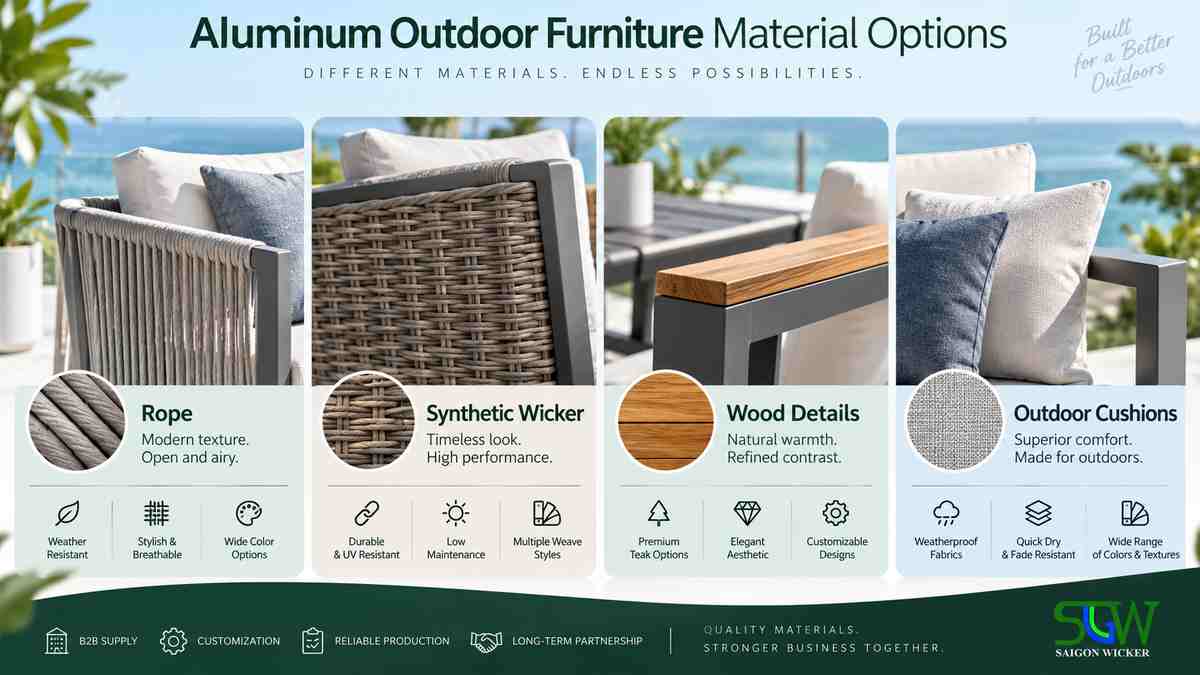
9. Evaluate the Materials Combined With the Aluminum Frame
Few outdoor collections use bare aluminum alone.
The frame may be combined with:
- Outdoor rope
- PP or PE synthetic wicker
- Textilene
- Teak or other outdoor wood
- Tempered glass
- Aluminum slats
- Outdoor fabrics
- Foam cushions
This means the overall performance of aluminum outdoor furniture depends on more than the frame.
A strong frame cannot compensate for poorly specified woven material, weak stitching, unsuitable foam, inconsistent fabric, or an unstable tabletop.
Buyers comparing woven options can also read our
Outdoor Rope vs PP Rattan guide
.
For products where low maintenance is a priority, see our guide to
low-maintenance patio furniture
.
10. Define Quality Control Before Mass Production
Quality control should not begin when the container is ready to load.
For aluminum outdoor furniture, QC should follow the product through several stages.
Depending on the order and factory system, inspection points may include:
- Incoming materials
- Tube dimensions
- Frame fabrication
- Welding
- Frame alignment
- Grinding and surface preparation
- Powder-coating appearance
- Dimensions
- Weaving or Textilene installation
- Wood components
- Cushions
- Hardware
- Assembly
- Stability
- Final appearance
- Packaging
The approved sample, drawings, color references, material specifications, and packaging requirements should form the basis for inspection.
Saigon Wicker describes its quality approach as a multi-stage system extending from raw material checks through final shipment.
Learn more about
Saigon Wicker’s manufacturing and quality approach
.
Should Aluminum Outdoor Furniture Be KD or Fully Assembled?
There is no universal answer.
Fully assembled furniture can reduce assembly requirements at destination, while knock-down construction may improve carton dimensions and container utilization.
The right option depends on:
- Product design
- Structural requirements
- Buyer market
- Retail model
- Assembly expectations
- Packaging cost
- Container volume
For KD aluminum outdoor furniture, buyers should carefully review connection points, hardware, assembly instructions, and repeat assembly performance.
Container efficiency should never be improved by creating a connection system that compromises stability or creates unnecessary customer complaints.
How Should Aluminum Outdoor Furniture Be Packed?
Powder-coated surfaces can be scratched during handling if frames are allowed to rub against one another.
Packaging should therefore protect exposed frame sections, corners, legs, tabletops, woven materials, cushions, and hardware according to the product design.
Buyers should request:
- Carton dimensions
- Net weight
- Gross weight
- CBM
- Packing method
- Number of units per carton
- Hardware packing method
- Estimated container loading quantity
Packaging must be evaluated together with landed cost.
A slightly more expensive product can still offer stronger commercial value if its design and packing configuration allow better container utilization and fewer transit claims.

What Actually Affects the Price of Aluminum Outdoor Furniture?
Buyers should be careful when comparing quotations based only on the finished product image.
Pricing may be influenced by:
- Aluminum specification
- Tube profile
- Wall thickness
- Total material usage
- Frame complexity
- Welding requirements
- Powder-coating specification
- Rope, wicker, Textilene, or wood
- Fabric and cushion construction
- Hardware
- MOQ
- Packaging
- Testing requirements
- Customization
For this reason, a quotation for aluminum outdoor furniture should be compared against an agreed product specification.
If two suppliers are quoting different materials and constructions, the prices are not directly comparable even if the products look similar in photographs.
What Should Buyers Check on the Approval Sample?
Before mass production, the approval sample should be evaluated as both a design reference and a manufacturing reference.
Check:
- Overall dimensions
- Seat height and depth
- Frame proportions
- Tube specification
- Welding
- Frame alignment
- Powder-coating color and texture
- Surface finish
- Stability
- Comfort
- Woven materials
- Cushion thickness
- Tabletop construction
- Hardware
- KD assembly where applicable
Any approved revisions should be documented rather than communicated only through informal messages.
The goal is for bulk production to reproduce the approved aluminum outdoor furniture specification consistently.
B2B Aluminum Outdoor Furniture Buying Checklist
Before confirming an order, buyers should be able to answer the following:
- What aluminum specification is being used?
- What are the important tube dimensions and wall thicknesses?
- How is the frame reinforced?
- What welding standard has been approved?
- How is drainage handled?
- What pretreatment and powder-coating system is used?
- What environment will the furniture be used in?
- What hardware is specified?
- What other outdoor materials are combined with the frame?
- What QC checkpoints will be used?
- Is the product KD or fully assembled?
- What are the carton dimensions and CBM?
- What is the estimated container quantity?
- Which sample and specification will control mass production?
Aluminum Outdoor Furniture Manufacturing at Saigon Wicker
Saigon Wicker develops and manufactures outdoor furniture for international B2B markets, including importers, wholesalers, retailers, and hospitality buyers.
Our product capabilities include powder-coated aluminum frames combined with outdoor rope, synthetic wicker, wood, glass, Textilene, outdoor fabrics, and cushions.
Depending on product feasibility and buyer requirements, customization may include frame dimensions, colors, surface finishes, weaving materials, fabrics, cushions, tabletops, configurations, labels, and export packaging.
As an aluminum outdoor furniture manufacturer in Vietnam, our goal is to move from an approved specification and sample into repeatable production with clear quality requirements.
Learn more about
Saigon Wicker’s manufacturing capabilities
.
Frequently Asked Questions
Is aluminum good for outdoor furniture?
Aluminum is widely used for outdoor furniture because it is lightweight, workable, and can be combined with protective surface finishes. Final performance still depends on alloy, frame construction, welding, coating, hardware, product design, and intended environment.
Does aluminum outdoor furniture rust?
Aluminum does not form iron rust in the same way as steel, but it can still experience corrosion under certain conditions. Buyers should therefore evaluate alloy selection, pretreatment, coating quality, drainage, hardware, and environmental exposure.
What should B2B buyers check on an aluminum furniture frame?
Important areas include aluminum specification, tube dimensions, wall thickness, welding, reinforcement, alignment, drainage, powder coating, hardware, stability, and the approved sample.
Why is powder coating used on aluminum outdoor furniture?
Powder coating provides a decorative surface and can contribute to protection of the aluminum substrate. Performance depends on the entire coating system, including pretreatment, powder specification, application, curing, and quality control.
Is aluminum outdoor furniture suitable for coastal areas?
It can be, but coastal environments can be significantly more corrosive because of chloride exposure. Buyers should disclose the intended environment and define appropriate material, coating, hardware, testing, and maintenance requirements with the supplier.
Can aluminum outdoor furniture be customized?
Yes. Depending on production feasibility, buyers may customize dimensions, frame colors, surface finishes, rope or wicker, fabrics, cushions, tabletops, configurations, branding, and packaging.
What information should I provide when requesting a quotation?
Provide product drawings or reference images, dimensions, estimated quantity, target market, frame requirements, colors, woven materials, cushion specifications, packaging requirements, testing requirements, and expected delivery schedule whenever available.
Choose Aluminum Outdoor Furniture by Specification, Not Appearance Alone
Aluminum outdoor furniture can offer excellent flexibility for residential retail, hospitality, wholesale, and project collections.
But successful B2B sourcing depends on what sits behind the product image.
Buyers should evaluate the aluminum specification, tube construction, welding, drainage, powder coating, hardware, combined materials, quality control, packaging, and intended environment before confirming production.
The goal is not simply to buy an aluminum chair or sofa. It is to approve a repeatable product specification that delivers the right balance of design, performance, cost, and logistics for the target market.
Discuss Your Aluminum Outdoor Furniture Project With Saigon Wicker
If you are developing an aluminum dining collection, sofa range, coffee set, sun lounger, modular program, or customized outdoor furniture project, share your requirements with our team.
Contact Saigon Wicker
with your drawings, reference images, target quantities, material specifications, finishes, packaging requirements, or project brief.