
For importers, wholesalers, retailers, hospitality buyers, and sourcing companies, understanding outdoor furniture packaging makes it easier to evaluate quotations, compare suppliers, plan container quantities, and reduce avoidable damage during transit.
This guide explains how outdoor furniture can be prepared, protected, packed, marked, and loaded for export — and what B2B buyers should confirm before approving a shipment.

Why Outdoor Furniture Packaging Matters for B2B Buyers
A furniture order may leave the production line in excellent condition but still arrive with scratches, crushed cartons, damaged corners, broken glass, deformed cushions, or missing hardware if the packing specification is not suitable for the product and transport route.
This is why a professional supplier should consider outdoor furniture packaging during product development rather than waiting until production is complete.
Packaging decisions can influence:
- Protection against scratches and surface damage
- Protection of corners, legs, armrests, and tabletops
- Carton size and CBM
- Container loading quantity
- Knock-down or fully assembled construction
- Warehouse handling
- Assembly at destination
- Retail or project distribution
- Total landed cost
The right solution is not necessarily the packaging with the most material. It is the packaging that provides suitable protection while remaining practical, efficient, and appropriate for the product.
1. Confirm the Packing Specification Before Mass Production
Good outdoor furniture packaging begins before cartons are ordered.
The packing method should ideally be reviewed together with the approved product sample, dimensions, hardware, and product construction.
Buyers should confirm whether the product will be:
- Fully assembled
- Partially assembled
- Knock-down (KD)
- Stacked
- Nested
- Packed individually
- Packed as multiple pieces in one carton
Each method affects carton dimensions, assembly requirements, protection points, and container utilization.
For example, converting a table or chair into a KD structure may reduce packing volume, but the product must still maintain structural stability and remain straightforward for the destination market to assemble.
A reliable B2B supplier should therefore evaluate packaging together with product engineering rather than treating the carton as an independent component.
2. Inspect, Clean, and Prepare Furniture Before Packing
Furniture should normally be checked before protective materials are applied.
Once a chair, sofa, table, or lounger is completely wrapped and placed into a carton, many visual details become difficult to inspect.
Pre-packing checks may include:
- Product dimensions
- Frame alignment
- Welding appearance
- Powder-coating finish
- Rope or wicker condition
- Wood surfaces
- Tabletop condition
- Cushion fit
- Hardware
- Assembly
- Stability
- Overall appearance
Products should also be sufficiently clean and dry before final outdoor furniture packaging is closed.
This reduces the risk of dirt, production residue, or trapped moisture being sealed inside the packaging during transportation.
3. Protect Frames, Finishes, Rope, and Wicker
Outdoor furniture often contains exposed surfaces that can rub against packaging materials or other components during handling.
Common protection methods may include foam sheets, protective sleeves, plastic wrapping, non-abrasive protective material, corner protectors, or cardboard separators depending on the design.
Particular attention should be given to:
- Chair and sofa legs
- Armrest corners
- Powder-coated frame edges
- Exposed welding areas
- Wooden armrests
- Rope finishing points
- Wicker corners
- Surfaces that contact another product during nesting or stacking
For powder-coated aluminum or steel furniture, protection should help prevent direct rubbing that could cause scratches during transportation.
Woven furniture also requires suitable handling. Rope or synthetic wicker should not be compressed in a way that permanently changes the weaving pattern or creates unnecessary surface pressure.
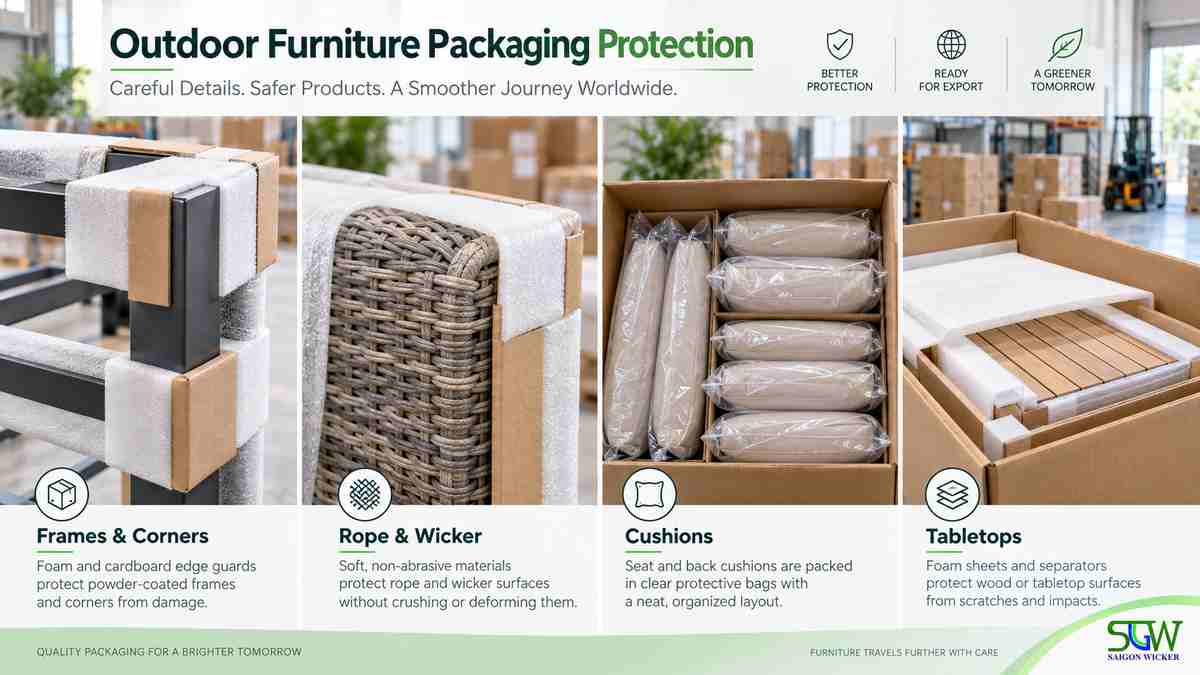
4. Pack Cushions and Outdoor Fabrics Carefully
Cushions create a different packaging challenge from metal or wood components.
They must remain clean, maintain their shape, and fit efficiently within the overall carton or furniture structure.
Depending on the product and buyer requirements, cushions may be:
- Placed inside the furniture frame
- Packed in protective plastic bags
- Packed separately
- Compressed within acceptable limits
- Combined with other cushions from the same set
Excessive compression should be avoided where it could negatively affect foam recovery, cushion shape, piping, or fabric appearance.
Buyers should also confirm how seat cushions, back cushions, decorative pillows, and removable covers are identified when several components belong to one furniture set.
For B2B programs with multiple SKUs, clear organization helps reduce assembly and warehouse errors at destination.
5. Protect Glass, Wood, and Tabletop Surfaces
Tabletops often require more specialized outdoor furniture packaging because damage to one exposed surface can make the entire table unsuitable for sale.
Tempered Glass
Glass should be protected against direct impact, edge pressure, movement inside the carton, and contact with hard furniture components.
The glass should not be able to move freely during transport.
Wood Tabletops
Wood surfaces may require protection against scratches, rubbing, pressure marks, and contact with metal hardware.
Protective materials should be suitable for the approved wood finish and should not damage or mark the surface.
Aluminum or Other Finished Tabletops
Powder-coated, painted, or decorative surfaces should also be separated from components that could create scratches during vibration and handling.
For products containing removable tabletops, the packing specification should clearly define the position of the tabletop and the protection between individual components.
6. Secure Hardware, Assembly Parts, and Instructions
For KD outdoor furniture, hardware management is an important part of the shipment.
A product may arrive without any cosmetic damage and still create a customer claim if the bolts, screws, washers, feet, brackets, or assembly instructions are missing.
Hardware packs should be clearly organized and secured so they cannot move freely around the carton.
Depending on the project, a hardware package may include:
- Bolts
- Screws
- Washers
- Brackets
- Adjustable feet
- Tools
- Spare components
- Assembly instructions
For retail programs, buyers may also require SKU labels, part numbers, barcode information, or market-specific assembly documents.
A well-designed outdoor furniture packaging specification should make it easy to identify which hardware belongs to each product.
7. Design Cartons Around Product Protection and CBM
Carton design influences both product protection and logistics cost.
A carton that is unnecessarily large may increase CBM, reduce container quantity, and increase freight cost per unit.
A carton that is too tight may create excessive pressure on furniture, cushions, woven surfaces, or tabletops.
B2B buyers should therefore review:
- Carton dimensions
- Net weight
- Gross weight
- CBM per carton
- Units per carton
- Carton construction
- Internal protection
- Handling orientation
- Stacking requirements
These details become particularly important when comparing quotations from different suppliers.
A slightly higher unit price with more efficient outdoor furniture packaging may sometimes produce a better total landed cost if substantially more products can fit into the same container.
8. Add Clear Carton Markings and Export Information
Export cartons usually require more information than the product name alone.
The exact carton marking depends on the buyer, market, warehouse, retailer, and shipping requirements.
Typical information may include:
- Product name
- Item or SKU number
- Color or finish
- Quantity
- Carton number
- Net weight
- Gross weight
- Carton dimensions
- Country of origin where required
- Barcode or warehouse label
- Handling marks
Before printing production cartons, buyers should approve artwork, wording, barcode data, and label placement.
This is especially important for private-label and retail programs where several similar products may move through the same warehouse.
What About Wooden Pallets and Export Wood Packaging?
Some export programs may use wooden pallets, crates, blocking, bracing, or dunnage.
When raw wood packaging material is used in international trade, the applicable phytosanitary requirements should be confirmed for the destination market.
B2B buyers can review the
International Plant Protection Convention and ISPM 15 requirements
for information regarding regulated wood packaging material used in international trade.
Requirements should be confirmed before shipment rather than assumed, particularly when wooden pallets, crates, or dunnage are part of the packing method.
9. Optimize Container Loading and Cargo Securing
The final stage is moving packed furniture into the shipping container safely and efficiently.
Container loading is not simply about fitting the maximum possible number of cartons into the available volume.
The loading plan should also consider:
- Carton dimensions
- Carton strength
- Weight distribution
- Product orientation
- Stacking limitations
- Movement during transportation
- Loading and unloading access
- Cargo securing requirements

The
IMO/ILO/UNECE Code of Practice for Packing of Cargo Transport Units
provides international guidance regarding the packing and securing of cargo in transport units.
For furniture buyers, the commercial objective is to balance protection and space efficiency.
A container with poor utilization increases freight cost. A container loaded too aggressively may increase pressure on cartons and products.
This is why container quantity should be evaluated together with carton dimensions and the approved outdoor furniture packaging method.
What Packaging Information Should B2B Buyers Request?
Before confirming a purchase order or shipment, buyers should request sufficient information to understand how the product will travel.
A useful packaging specification may include:
- Packing method
- Fully assembled or KD construction
- Number of pieces per carton
- Carton dimensions
- Net weight
- Gross weight
- CBM
- Internal protection method
- Hardware packing method
- Carton artwork
- Barcode requirements
- Estimated loading quantity per container
For new or customized products, packaging can also be reviewed during sample development.
This allows the buyer and supplier to identify potential problems before mass production begins.
Common Outdoor Furniture Packaging Mistakes
Many packaging problems come from small details rather than major design failures.
Common issues may include:
- Metal components rubbing against each other
- Insufficient corner protection
- Loose hardware inside cartons
- Glass or tabletops moving during transport
- Cushions compressed beyond an appropriate level
- Furniture packed before surfaces are clean or dry
- Incorrect barcode or carton markings
- Cartons larger than necessary
- No clear assembly instructions
- Container layouts that create unnecessary empty space
These problems can often be reduced by confirming both the product specification and the packing specification before bulk production is completed.
Does Better Packaging Always Mean Higher Cost?
Not necessarily.
More packaging material does not automatically mean better protection.
The objective should be efficient engineering.
For example, changing a product from fully assembled to an appropriate KD structure may reduce carton volume. Improving nesting can increase container quantity. Better-positioned protection may reduce the need for excessive wrapping material.
For this reason, B2B buyers should evaluate outdoor furniture packaging based on total performance rather than carton cost alone.
The relevant commercial question is:
Does the packing method protect the product while supporting efficient transportation and practical handling at destination?
Outdoor Furniture Packaging at Saigon Wicker
Saigon Wicker manufactures outdoor furniture for international B2B markets, including importers, wholesalers, retailers, and hospitality buyers.
Our product capabilities include combinations of powder-coated aluminum, steel, rope, synthetic wicker, wood, glass, outdoor fabrics, and cushions.
Packaging requirements can vary significantly between a dining chair, sofa set, coffee table, sun lounger, modular collection, or custom OEM product.
For this reason, packaging and container requirements should be reviewed according to the actual product specification and buyer requirements.

Learn more about
Saigon Wicker’s outdoor furniture manufacturing capabilities
and
our approach to manufacturing, quality, and international B2B partnerships
.
Frequently Asked Questions
How is outdoor furniture packed for export?
Outdoor furniture is typically inspected, protected with suitable wrapping or separators, packed in cartons or other approved export packaging, labeled, and then loaded according to the product and shipping requirements. The exact method depends on materials, construction, dimensions, and destination.
What is the best packaging for outdoor furniture?
There is no single best method for every product. Effective outdoor furniture packaging should protect exposed surfaces, control movement inside the carton, protect fragile components, organize hardware, and use space efficiently.
Can outdoor furniture be packed knock-down for export?
Yes. Many furniture products can use KD construction where the design allows it. The engineering should ensure that the final assembled product remains stable while the reduced carton volume provides a practical logistics benefit.
How can furniture packaging reduce shipping costs?
Efficient carton dimensions, nesting, stacking, and suitable KD construction can reduce CBM and allow more products to fit into a container. Buyers should compare container quantity and landed cost rather than looking only at carton cost.
How should outdoor furniture cushions be packed?
Cushions should be protected from dirt and damage while maintaining acceptable shape and recovery. The exact method depends on foam, fabric, cushion design, available space, and buyer requirements.
Does export furniture packaging require ISPM 15?
ISPM 15 applies to regulated raw wood packaging material used in international trade, such as certain pallets, crates, and dunnage. Buyers should confirm the applicable phytosanitary requirements for the destination market whenever raw wood packaging is used.
What information should buyers request before container loading?
Buyers should consider requesting carton dimensions, CBM, gross and net weight, packing method, units per carton, estimated container quantity, carton markings, and final inspection information.
Good Outdoor Furniture Packaging Protects More Than the Product
Outdoor furniture packaging affects product condition, transportation efficiency, container quantity, warehouse handling, customer experience, and ultimately the total cost of an international order.
For B2B buyers, packaging should therefore be discussed during sourcing and product development — not only after mass production is complete.
A reliable supplier should be able to explain how frames, woven surfaces, cushions, tabletops, hardware, cartons, and container loading will be handled based on the actual product and destination requirements.
The goal is simple: protect the furniture, use shipping space efficiently, and help the approved product arrive as close as possible to the condition in which it left the factory.
Discuss Your Export Packaging Requirements With Saigon Wicker
If you are developing an outdoor furniture collection for retail, wholesale, hospitality, OEM, or ODM production, packaging requirements can be reviewed together with your product specifications.
Contact Saigon Wicker
and share your product drawings, reference images, order quantities, packaging requirements, destination market, or container targets with our team.