
However, the two woods should not automatically be treated as interchangeable.
For importers, wholesalers, retailers, hospitality buyers, and sourcing companies, understanding teak vs acacia outdoor furniture makes it easier to choose the right material for the right product and price level.
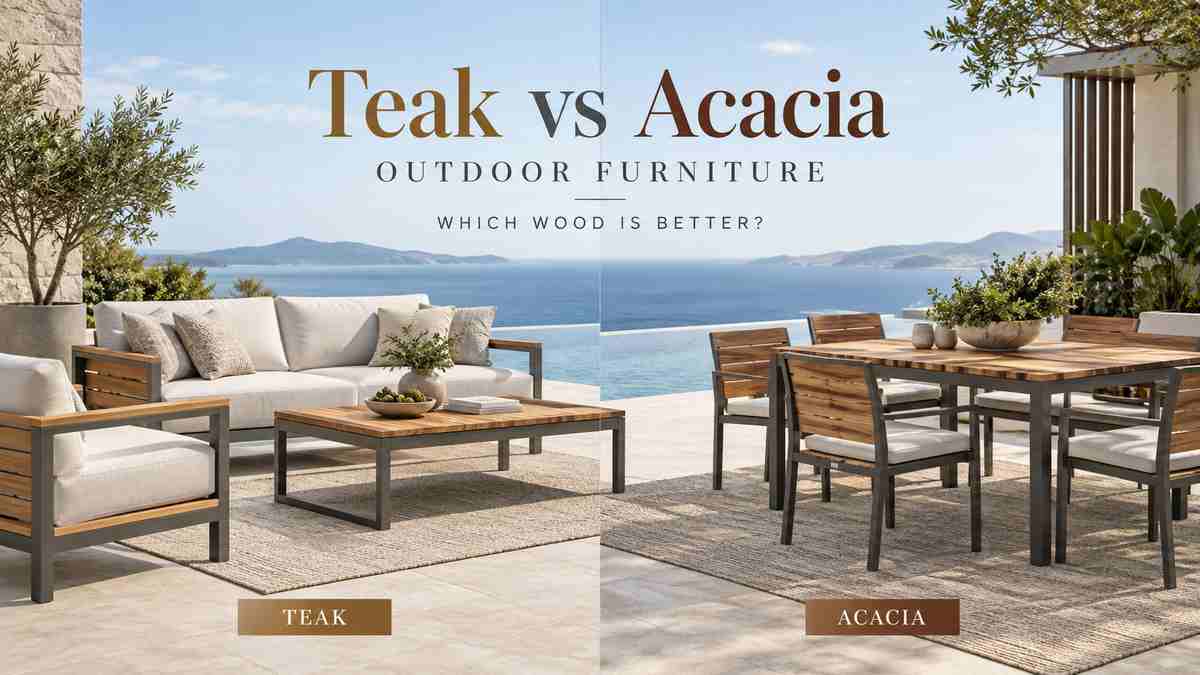
Teak vs Acacia Outdoor Furniture: Quick Comparison
The following table gives B2B buyers a practical starting point before evaluating each material in more detail.
| Factor | Teak | Acacia |
|---|---|---|
| Market positioning | Typically premium | Typically mid-range to value-driven |
| Natural appearance | Warm golden-brown tone with a refined grain | Warm natural tones with greater variation depending on species and supply |
| Outdoor suitability | Widely valued for outdoor applications | Can perform well outdoors when correctly specified, finished, and maintained |
| Dimensional stability | Generally strong | More dependent on species, moisture control, and construction |
| Maintenance | Depends on desired appearance and finish | Usually requires closer attention to finish and maintenance |
| Cost | Higher | Generally more accessible |
| Typical B2B use | Premium retail, resorts, hospitality, high-end collections | Retail collections, mixed-material programs, value-conscious projects |
The main point is that teak vs acacia outdoor furniture should be evaluated according to the complete product specification rather than wood species alone.
What Is Teak Outdoor Furniture?
Teak is one of the best-known woods used in premium outdoor furniture.
Its warm appearance, dimensional stability, and natural durability have made it a long-established material for furniture and other applications where resistance to changing environmental conditions is important.
For B2B outdoor furniture, Teak may be used for:
- Full wooden chairs and tables
- Dining tabletops
- Coffee table tops
- Armrest details
- Seat or back slats
- Decorative accents
- Mixed aluminum-and-wood collections
However, the word “Teak” alone is not a complete specification.
Buyers should still confirm wood quality, moisture condition, dimensions, construction, finish, sourcing documentation, and the intended environment before approving mass production.
What Is Acacia Outdoor Furniture?
Acacia refers to a large group of wood species and is widely used in furniture manufacturing because it can provide a natural wood appearance at a more accessible price point than premium Teak.
For outdoor collections, Acacia may be used for:
- Dining tables
- Chair frames
- Tabletops
- Armrests
- Slatted surfaces
- Accent details
- Mixed-material furniture
Because Acacia covers many species and supply sources, B2B buyers should avoid treating all Acacia products as identical.
When comparing teak vs acacia outdoor furniture, Acacia should be evaluated by the actual wood specification, moisture condition, finish system, construction, and maintenance expectation.
1. Teak vs Acacia Outdoor Furniture: Which Is More Durable?
Durability is often the first question buyers ask.
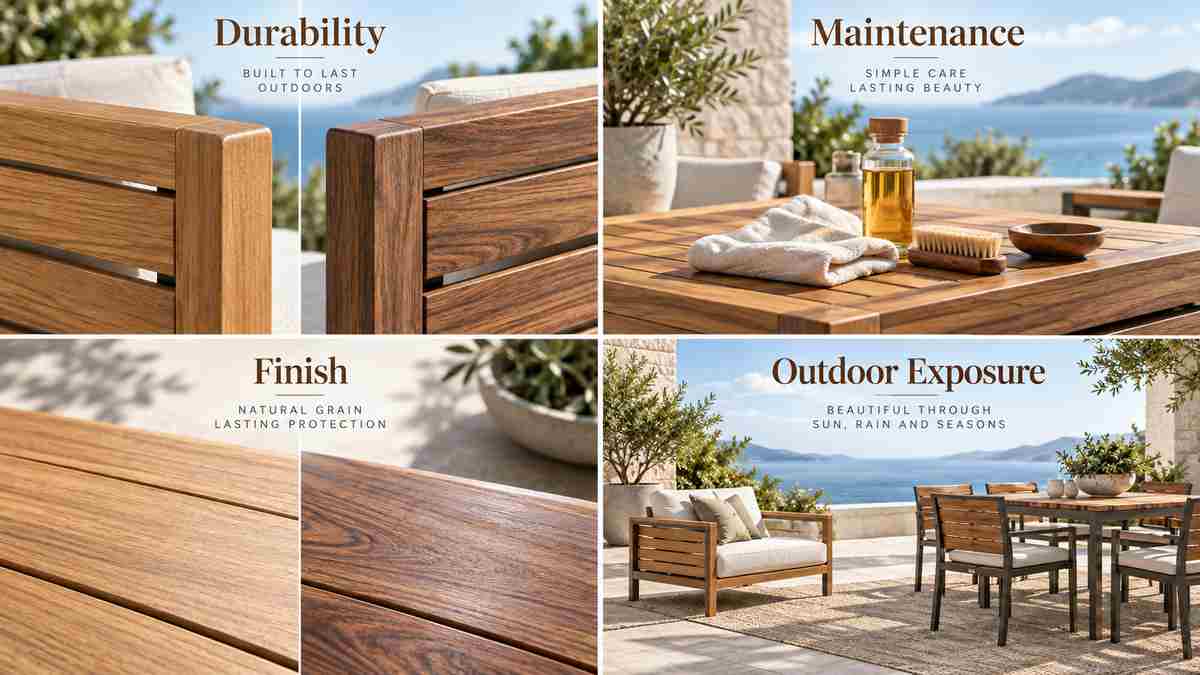
Teak is widely valued for its natural durability and stability, which is one reason it has a strong reputation in premium outdoor furniture.
Acacia can also be used successfully outdoors, but its performance is more dependent on the exact species, timber quality, drying process, finish, product construction, and maintenance.
This does not mean every Teak product will automatically outperform every Acacia product.
A poorly manufactured Teak table can still create problems, while well-specified and properly maintained acacia outdoor furniture can provide a practical solution for many markets.
For B2B buyers, durability should therefore be evaluated together with:
- Wood specification
- Moisture control
- Joint construction
- Slat spacing
- Drainage
- Surface finish
- Maintenance instructions
- Intended environment
2. Which Wood Has the Better Appearance?
This depends on the design direction.
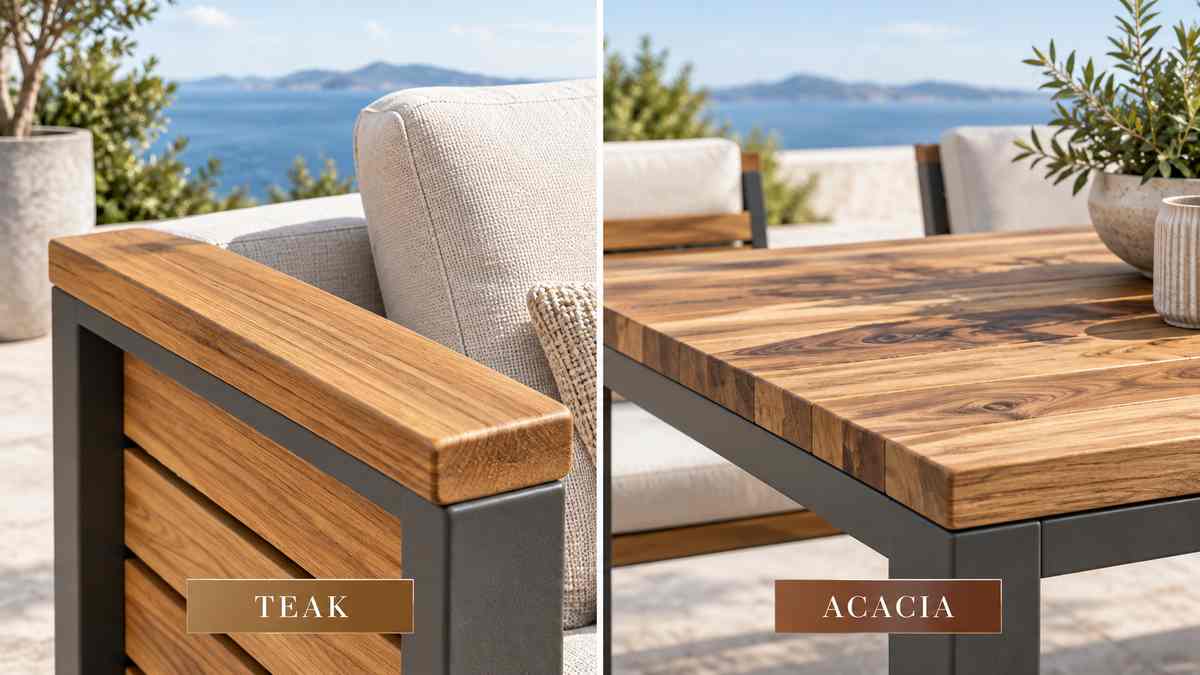
Teak is often selected for premium outdoor collections because its natural golden-brown appearance can create a refined and warm visual contrast against dark aluminum, rope, or neutral cushions.
Acacia can also provide strong natural character and may offer more visible variation in grain and tone.
Neither appearance is automatically better.
For premium resort furniture, Teak may support a more established high-end material story.
For retail collections where natural appearance must be balanced against target price, Acacia may be commercially attractive.
When evaluating teak vs acacia outdoor furniture, the visual decision should therefore reflect the intended customer and market positioning.
3. How Do Teak and Acacia Respond to Outdoor Exposure?
Outdoor wood is exposed to more than rain.
Furniture may experience:
- Sunlight
- Humidity
- Temperature changes
- Rain
- Cleaning
- Poolside splash
- Salt-containing coastal air
The performance of wood under these conditions depends on both the material and the complete furniture construction.
Water should not remain trapped in joints or on flat surfaces for unnecessary periods.
Slatted tabletops and seating surfaces should be designed with suitable spacing and drainage according to the product.
Buyers should also understand that natural wood changes visually outdoors.
Exposure to sunlight and weather can change color over time, especially when furniture is left untreated or when protective finishes gradually weather.
This should be explained to customers as a natural material characteristic rather than automatically treated as a manufacturing defect.
4. Which Requires More Maintenance?
Maintenance is an important part of the teak vs acacia outdoor furniture decision.
Teak can often be used with a relatively natural finish, depending on the buyer’s desired appearance and application.
Some buyers prefer to preserve its warmer original tone through cleaning and maintenance treatments, while others accept the natural color change associated with outdoor exposure.
Acacia outdoor furniture generally benefits from closer attention to protective finishing and periodic maintenance, especially in exposed outdoor environments.
The exact care routine should always follow the approved coating or finishing system.
B2B buyers should ask manufacturers for:
- Recommended cleaning method
- Maintenance frequency
- Recommended oil or finish where applicable
- Instructions for prolonged storage
- Advice for wet or coastal environments
This information can then be included in consumer or hospitality care instructions.
For additional maintenance considerations, see our
Low-Maintenance Patio Furniture guide
.
5. Construction Matters as Much as Wood Species
One of the biggest sourcing mistakes is selecting wood based only on species.
A well-designed outdoor table must allow for the natural behavior of wood.
Buyers should review:
- Slat dimensions
- Slat spacing
- Joint design
- Fasteners
- Support structure
- Movement allowance
- Drainage
- Moisture before production
Wood naturally responds to changes in moisture and humidity.
If a product is designed without considering this movement, problems can occur regardless of whether Teak or Acacia is used.
This is especially important when wood is combined with aluminum or steel because metal and timber respond differently to environmental changes.
For teak vs acacia outdoor furniture, good engineering can be just as important as the wood selection itself.
6. Teak and Acacia in Mixed-Material Outdoor Furniture
Wood does not need to form the entire furniture structure.
One of the most commercially useful approaches is combining natural wood with other outdoor materials.
Examples include:
- Powder-coated aluminum frame + Teak armrests
- Aluminum frame + Teak tabletop
- Aluminum frame + Acacia slats
- Rope seating + wood details
- Synthetic wicker + wood tabletop
- Metal dining table + natural wood surface
This allows manufacturers and buyers to use wood where its warmth and texture have the greatest visual impact while maintaining the structural advantages of metal frames.
A small amount of Teak on an armrest or tabletop can significantly change the perceived positioning of a collection.
Acacia can provide a similar natural contrast for products targeting a more accessible price level.
7. Which Wood Offers Better B2B Value?
Teak normally carries a higher material cost than Acacia.
However, the cheapest wood is not automatically the most cost-effective option.
The commercial calculation may include:
- Raw material cost
- Yield
- Machining
- Drying
- Finishing
- Maintenance expectations
- Target retail price
- Warranty positioning
- Replacement risk
- Brand positioning
For premium hospitality or high-end retail, the higher price of Teak may support the desired product positioning.
For larger-volume retail collections, Acacia may allow buyers to introduce natural wood while keeping the finished product within a more accessible target price.
The better choice in a teak vs acacia outdoor furniture comparison is therefore the material that creates the right balance between product performance, appearance, selling price, and customer expectations.
What Should Buyers Know About FSC-Certified Wood?
Responsible wood sourcing is increasingly important for international furniture programs.
When FSC-certified material is required, buyers should clearly define this requirement before quotation and sample development.
The
Forest Stewardship Council
provides information about responsibly sourced wood and FSC certification.
B2B buyers should confirm:
- Whether FSC material is required
- Which product components require certified wood
- Applicable documentation
- Chain-of-custody requirements
- Whether an FSC claim will appear on the final product or packaging
Certification requirements should be discussed at the beginning because they may affect sourcing, documentation, MOQ, price, and production planning.
Quality Control for Teak and Acacia Outdoor Furniture
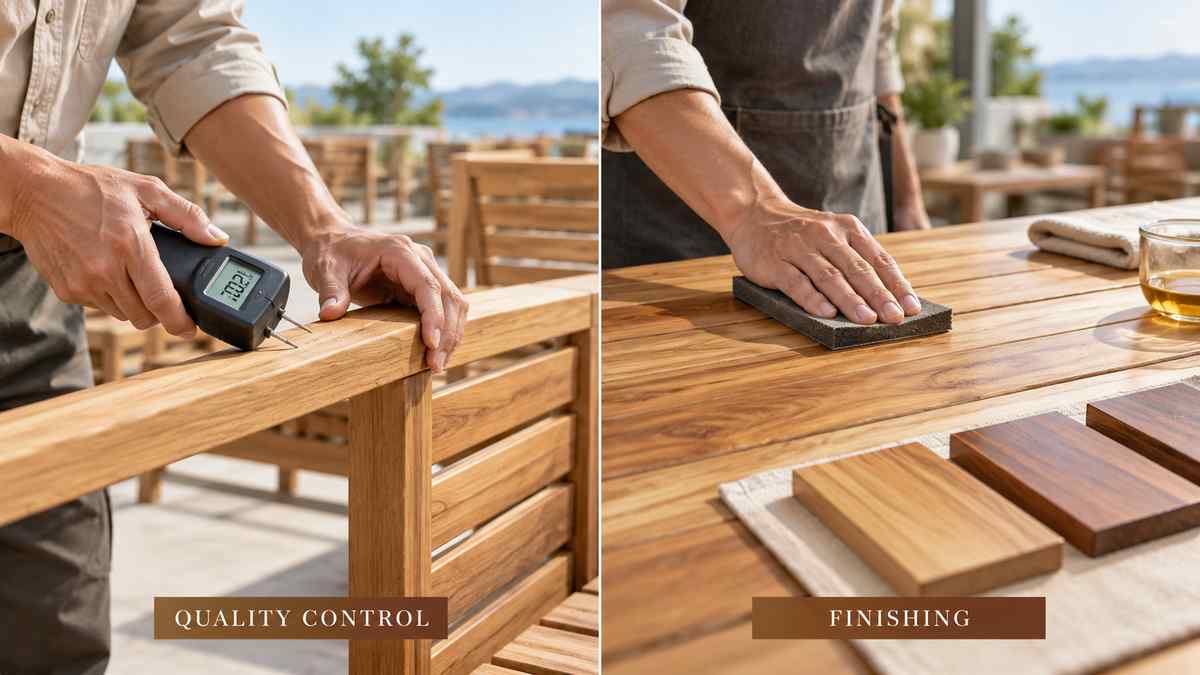
Wood quality control should begin before the product reaches final assembly.
Depending on the project, buyers may want checks covering:
- Species or material specification
- Moisture condition
- Dimensions
- Grain and visual defects
- Color consistency within approved limits
- Machining
- Sanding
- Slat spacing
- Joint construction
- Surface finishing
- Assembly
- Packaging protection
Natural wood will always contain more variation than a manufactured surface such as powder-coated aluminum.
The goal of quality control is therefore not to make every piece of wood visually identical.
It is to establish an acceptable standard for natural variation while controlling manufacturing defects.
Which Wood Is Better for Different Applications?
Premium Resorts and Hotels
Teak is often a strong option when the project requires natural materials, premium positioning, and long-term visual value.
Retail Outdoor Furniture
Both materials can work. Teak may support premium ranges, while Acacia can provide a natural wood story at a more accessible price point.
Dining Tables
Both can be considered, but buyers should pay close attention to tabletop construction, slat spacing, moisture control, finish, and maintenance.
Mixed Aluminum and Wood Collections
Teak can create a premium accent on armrests or tabletops. Acacia can achieve a warmer natural look while helping control target product cost.
Coastal Projects
Material selection should be evaluated together with the full environment, including humidity, salt exposure, hardware, frame coating, cleaning, drainage, and maintenance.
Teak vs Acacia Outdoor Furniture: Which Is Better?
There is no universal answer.
Choose Teak when:
- Premium positioning is important
- Natural durability is a priority
- The target market accepts a higher material cost
- The collection requires a recognized premium outdoor wood
- Long-term hospitality or premium retail positioning supports the investment
Consider Acacia when:
- Target price is more sensitive
- Natural wood appearance is still important
- The product has an appropriate outdoor finish
- The intended maintenance requirements can be communicated clearly
- The collection targets mid-range or larger-volume retail positioning
The teak vs acacia outdoor furniture decision should ultimately be based on the target market and complete product specification rather than material reputation alone.
B2B Wood Furniture Buying Checklist
Before approving a wooden outdoor furniture order, buyers should confirm:
- Wood species and specification
- Source and certification requirements
- Moisture requirements
- Dimensions and tolerances
- Construction method
- Slat spacing
- Joint details
- Hardware
- Surface finish
- Color expectation
- Maintenance instructions
- Packaging protection
- Approved sample
This checklist makes a teak vs acacia outdoor furniture comparison more useful than simply asking which wood is “better.”
Wood Outdoor Furniture Development at Saigon Wicker
Saigon Wicker develops outdoor furniture for international B2B markets using combinations of powder-coated aluminum, steel, outdoor rope, synthetic wicker, fabrics, cushions, glass, and natural wood.
Depending on product and project requirements, wood may be used for tabletops, armrests, slatted surfaces, decorative details, or larger structural components.
Saigon Wicker can also develop mixed-material collections where natural wood is combined with aluminum, rope, or other outdoor materials.
For buyers evaluating other material combinations, read our
Outdoor Rope vs PP Rattan guide
.
Learn more about
Saigon Wicker’s manufacturing capabilities
and
our approach to international B2B furniture manufacturing
.
Frequently Asked Questions
Is Teak better than Acacia for outdoor furniture?
Teak is generally positioned as the more premium outdoor wood because of its natural durability and stability. Acacia can still be a practical outdoor furniture material when correctly selected, dried, constructed, finished, and maintained.
Is Acacia suitable for outdoor furniture?
Yes. Acacia can be used for outdoor furniture, but performance depends on species, material quality, moisture control, construction, protective finish, maintenance, and environmental exposure.
Which is more expensive: Teak or Acacia?
Teak is generally more expensive than Acacia. Actual furniture pricing also depends on wood grade, dimensions, material usage, machining, finish, construction, certification, and order volume.
Does Teak outdoor furniture require maintenance?
Maintenance depends on the desired appearance and environment. Buyers should follow the approved cleaning and care specification for the particular product and finish.
Does Acacia outdoor furniture require maintenance?
Acacia generally benefits from appropriate protective finishing and regular maintenance, particularly when exposed directly to sun, rain, and humidity.
Can Teak and Acacia be combined with aluminum?
Yes. Both woods can be used as tabletops, armrests, slats, or decorative details with powder-coated aluminum frames, depending on product engineering and design requirements.
Can Teak or Acacia outdoor furniture be FSC-certified?
FSC certification depends on the source, supply chain, product scope, and documentation. Buyers requiring FSC-certified material should state this requirement before quotation and production.
Choose Outdoor Wood for the Market, Not the Name Alone
The teak vs acacia outdoor furniture decision should be based on more than wood reputation.
Teak offers strong premium positioning, natural durability, and a well-established outdoor furniture story. Acacia offers natural warmth and commercial flexibility at a generally more accessible material cost.
For B2B sourcing, buyers should consider material quality, moisture control, construction, finishing, maintenance, certification, target price, and intended environment before approving either option.
The best outdoor wood is the one that matches the product specification, target market, maintenance expectation, and commercial positioning of the collection.
Discuss Your Outdoor Wood Furniture Project With Saigon Wicker
If you are developing an outdoor dining set, sofa collection, coffee table, mixed aluminum-and-wood range, or customized hospitality project, share your material requirements with our team.
Contact Saigon Wicker
with your drawings, reference images, target quantities, wood requirements, finishes, packaging requirements, or project specifications.