
The key is understanding which changes are simple production options and which require technical development, new samples, tooling, additional MOQ, or extended lead time.
A capable custom outdoor furniture manufacturer should therefore help buyers translate commercial ideas into specifications that can be produced consistently at scale.
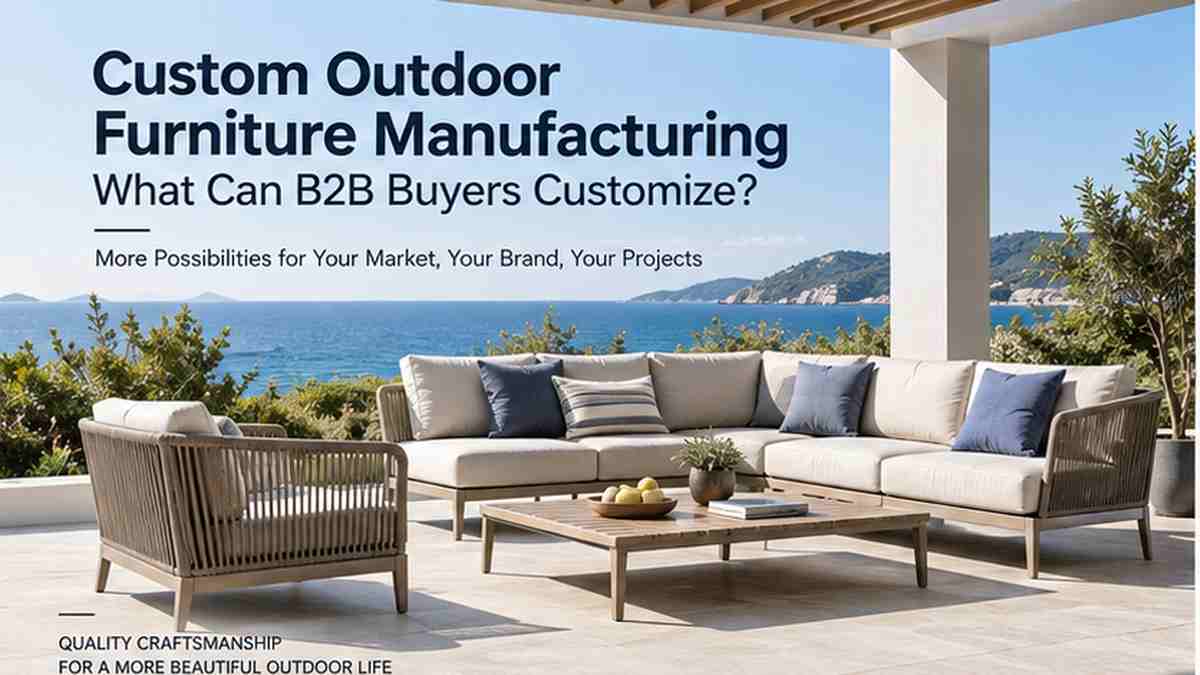
So, what exactly can B2B buyers customize?
Table of Contents
- Why Custom Outdoor Furniture Matters for B2B Buyers
- 1. Product Dimensions and Configurations
- 2. Frame Materials, Colors, and Finishes
- 3. Rope, Wicker, and Weaving Details
- 4. Cushion Fabrics, Foam, and Comfort
- 5. Tabletops, Wood Details, and Surface Materials
- 6. Seating Comfort and Product Construction
- 7. Branding, Labels, and Private-Label Requirements
- 8. Export Packaging and Container Efficiency
- 9. Collection-Level Customization
- How the Custom Manufacturing Process Works
- What Buyers Should Include in a Customization Brief
- Custom Outdoor Furniture at Saigon Wicker
- Frequently Asked Questions
Why Custom Outdoor Furniture Matters for B2B Buyers
Outdoor furniture is sold into very different markets.
A sofa developed for a European retailer may need different dimensions, colors, cushion construction, packaging, and price positioning from a similar product developed for a seaside resort, hotel project, American wholesaler, or private-label brand.
This is why customization should begin with the commercial objective rather than the color chart.
A professional custom outdoor furniture manufacturer should first understand where the product will be sold, who will use it, the expected quantity, target price level, required materials, destination market, and logistical requirements.
Those factors help determine how far an existing design can be modified and whether the project should follow an ODM, OEM, or more limited customization route.
1. Customize Product Dimensions and Configurations
Dimensions are one of the most valuable areas of outdoor furniture customization.
B2B buyers may need to modify the overall width, depth, seat height, armrest height, backrest height, tabletop dimensions, or spacing between individual components.
Hospitality buyers may require furniture to fit specific balconies, terraces, pool decks, or resort layouts. Retailers may need proportions that better match the body dimensions and living spaces of customers in a particular market.
Configurations can also be adjusted.
For example, a modular sofa program may include a two-seater, three-seater, corner section, middle unit, ottoman, lounge chair, and coffee table developed around one coordinated design language.
A custom outdoor furniture manufacturer should review dimensional changes carefully because changing width or depth may also affect frame strength, cushion construction, ergonomics, packaging volume, and material usage.
For this reason, significant dimensional changes should normally be confirmed through technical drawings and sample approval before mass production.
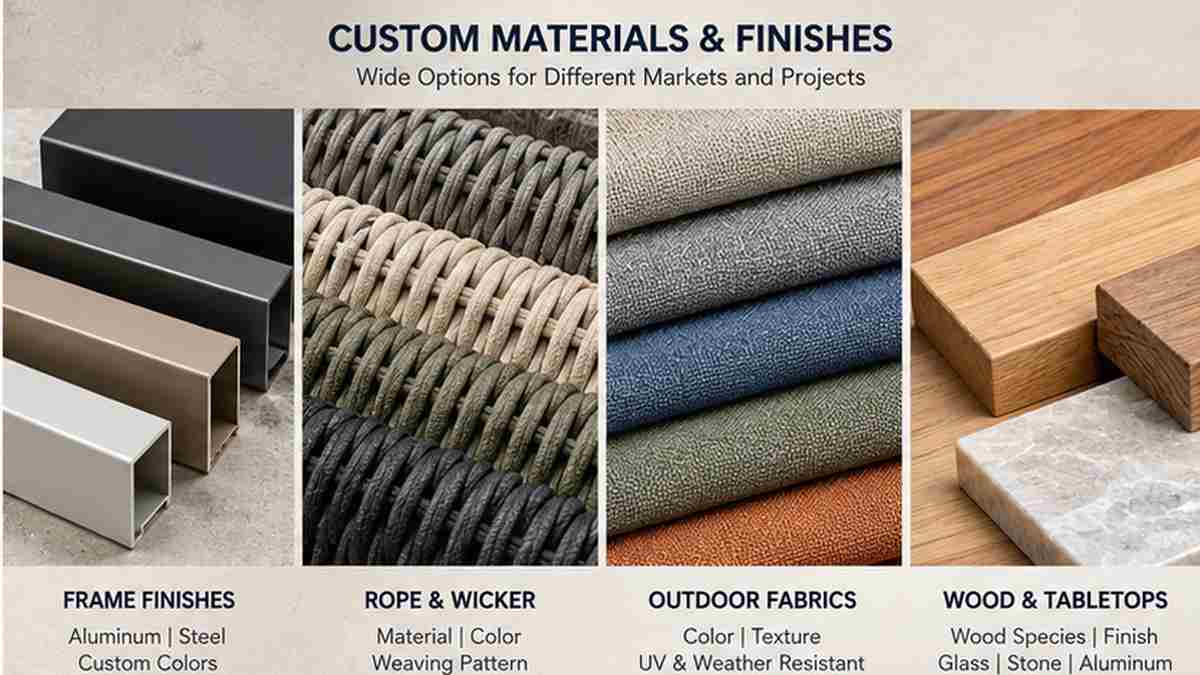
2. Customize Frame Materials, Colors, and Finishes
The frame forms the structural foundation of the product and also plays a major role in its visual character.
Depending on the collection, outdoor furniture may use powder-coated aluminum, steel, wood, or combinations of several materials.
For aluminum outdoor furniture, buyers may customize elements such as:
- Frame color
- Powder-coating finish
- Surface texture
- Matte or smoother visual appearance
- Tube profiles where technically feasible
- Knock-down or fixed construction
- Selected wood-look or heat-transfer details
A buyer developing a premium neutral collection may choose beige, greige, bronze taupe, dark grey, or black. Another market may require warmer or more distinctive colors.
A reliable custom outdoor furniture manufacturer should confirm approved finish references before mass production so the final collection maintains consistent color and appearance across different SKUs.
3. Customize Rope, Wicker, and Weaving Details
Woven materials can completely change the personality of an outdoor furniture collection.
Depending on the product, buyers may select outdoor rope, PP rattan, PE wicker, or other synthetic woven materials.
Customization can involve:
- Material type
- Rope or rattan profile
- Diameter or width
- Color
- Weaving direction
- Weaving density
- Pattern
- Combination of woven and exposed frame areas
Even when two chairs share the same aluminum structure, changing the woven material can produce very different market positioning.
A fine neutral rope may create a cleaner architectural appearance, while a wider synthetic wicker profile can produce a more natural or traditional outdoor look.
Buyers comparing these materials can also review our
Outdoor Rope vs PP Rattan guide
for a deeper comparison of design and application considerations.
Before approving bulk production, a custom outdoor furniture manufacturer should confirm physical color references, weaving samples, and material specifications rather than relying only on digital images.
4. Customize Cushion Fabrics, Foam, and Comfort
Cushions are another major area where B2B buyers can differentiate a collection.
Customization may include:
- Fabric type
- Fabric color
- Fabric weight
- Solid or striped appearance
- Seat cushion thickness
- Back cushion thickness
- Foam density or construction
- Removable covers
- Zipper details
- Piping
- Decorative pillows
- Velcro or cushion-fixing solutions
Cushion specifications should reflect the product’s intended environment and price level.
A hospitality lounge collection designed for extended seating may require a different comfort specification from compact balcony furniture intended for occasional residential use.
Fabric requirements may also vary by destination market and project specification.
For textile-related certification and testing information, buyers can review resources provided by
OEKO-TEX
.
An experienced custom outdoor furniture manufacturer should evaluate cushion proportions together with the frame because comfort depends on the relationship between seat depth, seat height, back angle, foam, and cushion thickness.
5. Customize Tabletops, Wood Details, and Surface Materials
Tables and accent surfaces offer another layer of customization.
Depending on the design, buyers may choose between materials such as aluminum slats, tempered glass, solid wood, heat-transfer aluminum, or other suitable outdoor surfaces.
Wood details may also be introduced on armrests, tabletops, seat bases, or decorative sections.
Possible customization areas include:
- Tabletop material
- Slat direction
- Slat spacing
- Wood species where available
- Wood tone
- Surface finish
- Glass color or treatment
- Table size and height
When responsible wood sourcing is required, buyers should define the documentation requirements early in the project.
Information about responsible forest certification can be reviewed through the
Forest Stewardship Council
.
A professional custom outdoor furniture manufacturer should treat tabletop changes as an engineering decision as well as a design decision because material weight, support structure, expansion, protection, and packaging may also change.
6. Customize Seating Comfort and Product Construction
Customization is not only visual.
Some of the most important changes are the ones customers may never notice directly.
Seat depth, backrest angle, cushion support, frame geometry, armrest position, textilene tension, woven-seat tension, and structural connections can influence comfort and usability.
Buyers developing products for hotels, resorts, restaurants, cafés, villas, or residential retail should define how the furniture is expected to be used.
For example, upright dining furniture requires a different seating posture from a deep lounge sofa or poolside daybed.
A capable custom outdoor furniture manufacturer should evaluate these changes during development instead of modifying dimensions independently without considering the complete seating experience.
7. Customize Branding, Labels, and Private-Label Requirements
For retailers, distributors, and private-label brands, customization often extends beyond the furniture itself.
Depending on the project, buyers may request:
- Product labels
- Hangtags
- Care labels
- Assembly instructions
- Barcode labels
- SKU information
- Carton markings
- Private-label documentation
- Market-specific product information
Brand artwork should be approved before production and coordinated with the packaging specification.
This is particularly important for retail programs involving multiple SKUs, because incorrect labels or carton markings can create warehouse and distribution problems even when the furniture itself is correct.
A custom outdoor furniture manufacturer supporting private-label programs should therefore manage product specifications and packaging artwork as part of the same approval process.
8. Customize Export Packaging and Container Efficiency
Packaging is often overlooked during product development, but for B2B buyers it can directly affect landed cost, damage risk, warehouse handling, and container efficiency.
Possible packaging decisions include:
- Fully assembled or knock-down construction
- Individual carton or multi-piece packing
- Protective foam placement
- Corner protection
- Surface protection
- Cushion packing
- Hardware bags
- Assembly instructions
- Carton dimensions
- Barcode and carton labels
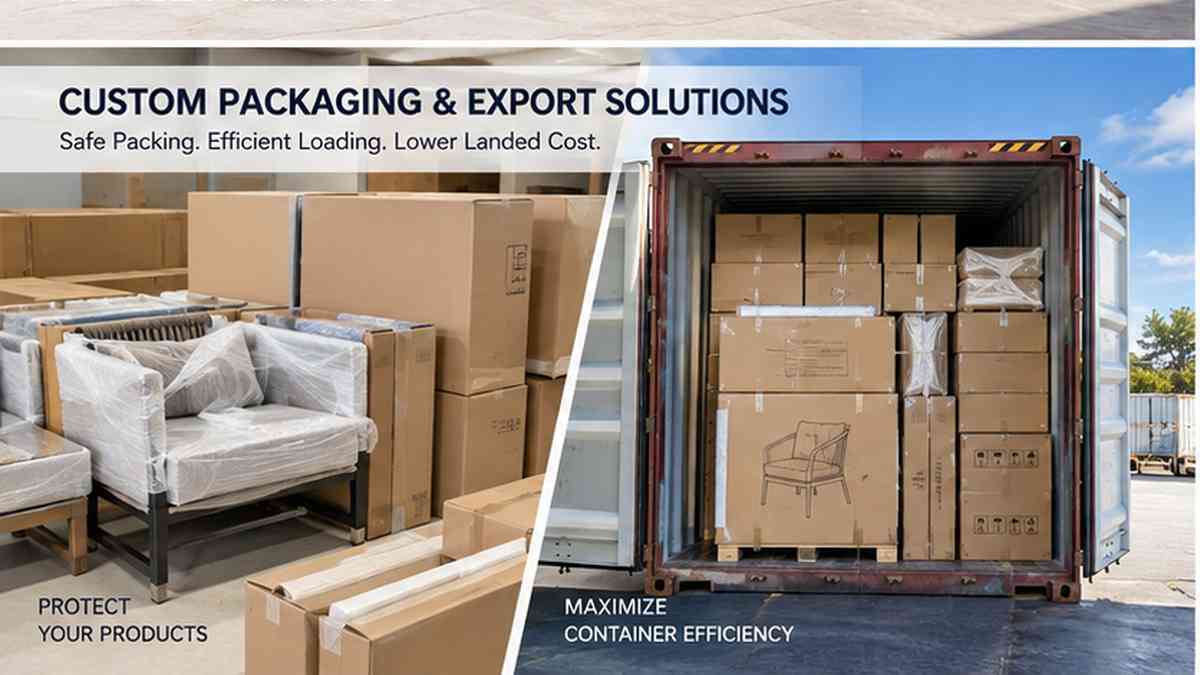
Furniture is a high-volume product category, so CBM can have a significant effect on shipping cost per unit.
In some cases, a custom outdoor furniture manufacturer may be able to adjust KD construction or packaging configuration to improve loading efficiency while preserving the approved design and structural requirements.
Buyers should ask for carton dimensions, gross weight, net weight, CBM, packing method, and estimated container loading quantity before final order confirmation.
9. Customize an Entire Collection, Not Just One Product
For B2B buyers, one of the greatest advantages of custom manufacturing is the ability to create a coordinated product family.
Instead of developing individual products independently, a collection can share the same materials, frame finish, rope color, cushion fabric, wood tone, and design language.
A coordinated outdoor range might include:
- Sofa
- Armchair
- Coffee table
- Dining chair
- Dining table
- Bar chair
- Sun lounger
- Daybed
- Side table
This allows retailers and wholesalers to present a stronger merchandising story while helping hospitality buyers maintain visual consistency across different zones of a project.
Saigon Wicker product collections already demonstrate customization across frame colors, cushion fabrics, dimensions, configurations, materials, labeling, and export packaging.
For example, buyers can explore the
SOLARIS full aluminum outdoor corner sofa set
or the
MONTEGO outdoor rattan wood sofa set
to see how different material directions can support different outdoor markets.
How Does Custom Outdoor Furniture Manufacturing Work?
A structured development process is essential when working with a custom outdoor furniture manufacturer.
A typical B2B workflow may follow these stages:
- Project brief: buyer shares drawings, reference images, specifications, quantities, destination market, and target requirements.
- Feasibility review: the manufacturing team reviews dimensions, materials, construction, customization requirements, MOQ, and production feasibility.
- Material selection: frame finish, rope or wicker, fabric, cushion, wood, tabletop, hardware, and other details are confirmed.
- Technical development: drawings and product construction are reviewed or developed.
- Sample development: a physical sample is produced for evaluation.
- Sample review: dimensions, comfort, appearance, materials, colors, stability, and other details are checked.
- Revision and approval: changes are documented and the final sample or specification is approved.
- Mass production: production follows the approved reference.
- Quality control and packing: finished products are inspected and prepared for shipment.
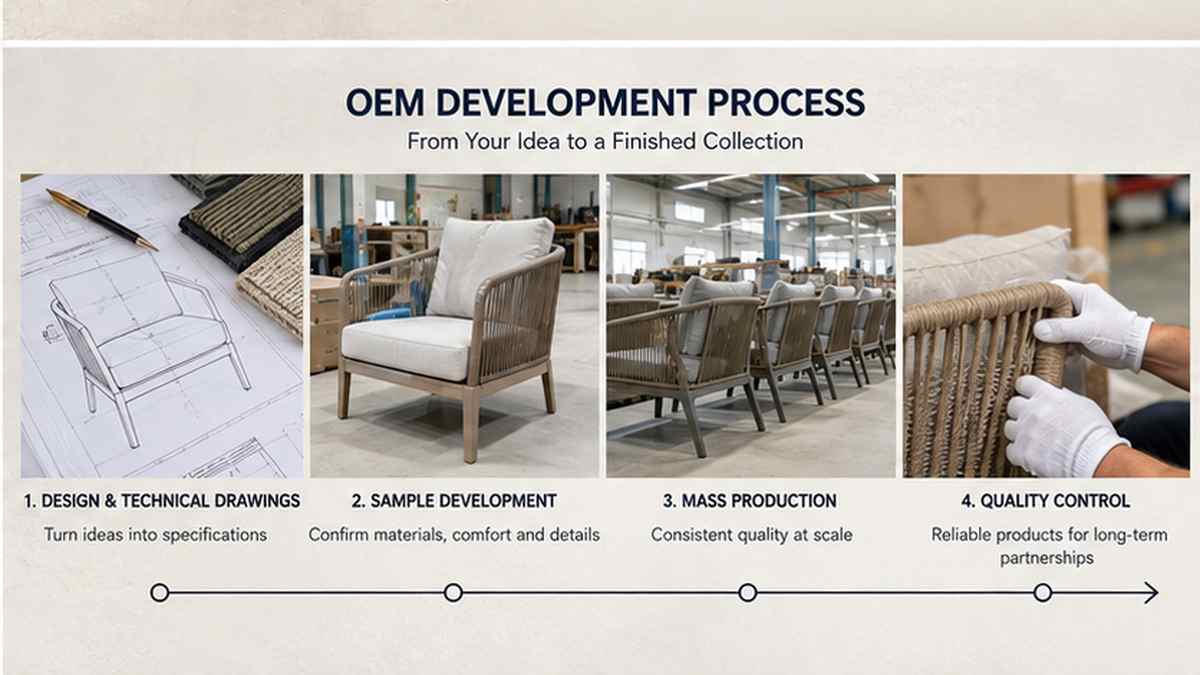
The objective is to create one clear production reference.
Drawings, dimensions, materials, colors, fabric references, construction details, packaging, and approved changes should be documented before mass production begins.
OEM vs ODM: How Much Customization Do You Need?
Not every B2B project needs full OEM development.
ODM Customization
ODM may be suitable when buyers want to start with an existing factory design and adjust selected elements such as colors, fabrics, materials, dimensions, packaging, or branding.
This route can reduce development complexity when the core construction already meets the market requirement.
OEM Development
OEM is more appropriate when buyers bring their own drawings, product concepts, technical specifications, reference samples, or unique design requirements.
OEM usually requires deeper technical evaluation and sample development.
The right route depends on product complexity, quantity, budget, timeline, and the level of differentiation required.
What Cannot Always Be Customized?
Customization does not mean every requested change is automatically practical.
A responsible custom outdoor furniture manufacturer should explain where a request may affect structural safety, manufacturing feasibility, MOQ, lead time, tooling, cost, packaging, or compliance.
For example, changing the width of a frame may require more than simply extending one tube. It may affect frame support, cushion dimensions, welding positions, packaging size, and stability.
Similarly, a completely new color, fabric, component, or material may carry a different MOQ from an existing approved production option.
For B2B buyers, the best customization process is therefore collaborative.
The manufacturer should not simply say yes to every request. It should identify the most practical way to achieve the buyer’s commercial objective while maintaining production consistency.
What Should B2B Buyers Include in a Customization Brief?
A detailed brief helps a custom outdoor furniture manufacturer provide a more accurate feasibility assessment and quotation.
Whenever possible, include:
- Product category
- Reference images or technical drawings
- Required dimensions
- Estimated order quantity
- Target market or destination country
- Preferred frame material
- Frame color and finish
- Rope or wicker requirements
- Fabric and cushion requirements
- Wood or tabletop requirements
- Branding and labeling requirements
- Packaging requirements
- Target delivery schedule
- Testing or compliance requirements
A clear RFQ reduces assumptions and allows the supplier to separate standard customization options from changes requiring additional development.
Custom Outdoor Furniture Manufacturing at Saigon Wicker
Saigon Wicker supports international B2B buyers with outdoor furniture development for wholesale, retail, OEM, ODM, hospitality, and project applications.
Our product capabilities include combinations of powder-coated aluminum, steel, outdoor rope, synthetic wicker, wood, glass, outdoor fabrics, and cushions.
Depending on the product and project requirements, customization may include frame dimensions, frame colors, rope or rattan finishes, weaving patterns, cushion fabrics, cushion specifications, wood tones, tabletop materials, product configurations, labels, and export packaging.
As a custom outdoor furniture manufacturer in Vietnam, Saigon Wicker can review customer drawings, reference images, product specifications, and commercial requirements before sample development and mass production.
Learn more about
Saigon Wicker’s manufacturing background
and
why B2B buyers work with Saigon Wicker
.
Choosing the Right Custom Outdoor Furniture Manufacturer
The best customization program is not necessarily the one with the greatest number of options.
It is the one that helps the buyer create the right product for the right market while maintaining quality, feasibility, cost control, and repeat-order consistency.
When evaluating a custom outdoor furniture manufacturer, buyers should look at more than the final appearance of the sample.
Consider how the supplier manages technical specifications, materials, approvals, sample revisions, production, quality control, packaging, and repeat orders.
This is especially important for importers, wholesalers, retailers, hospitality groups, and private-label brands planning long-term collections rather than one-off purchases.
Frequently Asked Questions
What can be customized in outdoor furniture manufacturing?
B2B buyers may be able to customize dimensions, frame finishes, rope or wicker, weaving patterns, cushion fabrics, foam specifications, wood details, tabletops, configurations, labels, branding, and packaging depending on the product and production feasibility.
What is a custom outdoor furniture manufacturer?
A custom outdoor furniture manufacturer develops or modifies outdoor furniture according to buyer specifications, drawings, materials, dimensions, finishes, branding, or project requirements rather than offering only fixed standard products.
What is the difference between OEM and ODM outdoor furniture?
OEM generally involves manufacturing according to a buyer’s own design or technical requirements. ODM typically starts from an existing manufacturer-developed product that can be adapted through selected materials, colors, dimensions, finishes, packaging, or branding.
Can outdoor furniture dimensions be customized?
Yes, dimensions can often be adjusted, but significant changes should be reviewed for structural feasibility, comfort, material usage, packaging, and cost before sample development.
Can B2B buyers customize outdoor furniture colors and materials?
Yes. Depending on the product, buyers may select frame colors, powder-coating finishes, rope or wicker colors, fabrics, cushion specifications, wood tones, tabletop materials, and other surface details.
Can a manufacturer produce private-label outdoor furniture?
Private-label projects may include customized product specifications, labels, hangtags, carton markings, barcodes, packaging, and other buyer-specific requirements. These details should be approved before production.
What should I send to request a custom outdoor furniture quotation?
Send reference images or drawings, dimensions, materials, estimated quantity, target colors, cushion requirements, destination market, packaging needs, customization details, and target delivery schedule whenever available.
Start Your Custom Outdoor Furniture Project
Successful custom manufacturing starts with a clear understanding of the product and the market behind it.
Whether you are developing a new private-label collection, adapting an existing design, building a hospitality furniture package, or sourcing a coordinated outdoor range, the first step is defining the specifications that matter most to your business.
Looking for a custom outdoor furniture manufacturer in Vietnam?
Contact Saigon Wicker
and send us your drawings, reference images, target quantities, materials, or project specifications. Our team can review the requirements and discuss the next development steps with you.