
For importers, wholesalers, retailers, hospitality buyers and sourcing companies, selecting weather resistant outdoor furniture is therefore not simply a question of choosing a material labelled “outdoor.” The real performance depends on material specification, construction quality, finishing, drainage, maintenance and the environment where the furniture will be used.
A resort beside the sea may need a different material strategy from a covered café terrace. A rooftop restaurant exposed to wind creates different requirements from a shaded residential garden.
This guide compares seven common outdoor furniture materials and explains how B2B buyers can evaluate them for sun, rain and wind before placing an order.
[ez-toc]
Why Weather Resistant Outdoor Furniture Is More Than a Material Choice
No outdoor material performs exactly the same in every climate.
Sun, rain, humidity, coastal salt, temperature changes, wind and daily commercial use can affect furniture in different ways.
For this reason, buyers evaluating weather resistant outdoor furniture should consider three separate questions:
- How does the material react to UV and long-term sunlight?
- How quickly can the product drain and dry after rain?
- Is the complete furniture structure suitable for the expected wind conditions?
Material quality is only one part of the answer. Welds, joints, coating coverage, weaving tension, fabric construction, cushion drainage and frame geometry also influence long-term performance.
Saigon Wicker discusses many of these factors in its guide to low-maintenance patio furniture, where construction and drying performance are considered alongside the material itself.
1. Powder-Coated Aluminum: One of the Most Versatile Outdoor Materials
Powder-coated aluminum is one of the most widely used materials for weather resistant outdoor furniture because it provides a useful balance between relatively low weight, design flexibility and outdoor durability.
Performance in Strong Sun
Aluminum itself is not sensitive to UV in the same way as textiles or polymer weaving materials. However, the appearance of the finished product depends heavily on the powder coating system.
Coating quality, surface preparation and color selection can all influence how the furniture looks after long-term exposure.
Performance in Rain
Aluminum does not rust in the same way as carbon steel, which makes it attractive for humid and rainy environments.
However, corrosion resistance should never be evaluated from frame material alone. Damage to the coating, poorly sealed machined areas, trapped dirt and inadequate drainage may reduce performance.
Buyers sourcing furniture for coastal or demanding environments can review QUALICOAT coating and corrosion guidance when discussing aluminum finishing requirements with suppliers.
Performance in Wind
Aluminum’s relatively low weight makes furniture easier for hotel and restaurant staff to move, but lightweight products also require careful stability evaluation in windy areas.
Frame proportions, leg position, center of gravity and overall product dimensions should therefore be reviewed during sample development.
For rooftop terraces or very exposed locations, product-level stability matters more than simply specifying an aluminum frame.
2. Steel: Strong and Heavy, but Coating Protection Matters
Steel can provide greater weight and structural rigidity than aluminum, which can be useful for selected commercial furniture applications.
The additional mass may also help products feel more planted in normal outdoor use.
However, buyers should pay close attention to corrosion protection.
Rain and Humidity
Unlike aluminum, exposed carbon steel can rust when protective coatings are damaged.
Weld areas, edges, screw holes and connection points therefore require particular attention during quality control.
Stainless steel hardware is often preferred for outdoor furniture connections because these small components may receive frequent exposure to water during rain and cleaning.
When Steel Makes Sense
Steel can be suitable for dining bases, café furniture and designs where additional weight is desirable, but the coating system and intended environment should be specified clearly.
3. Outdoor Rope and PP Rattan: Weather Performance Depends on Specification
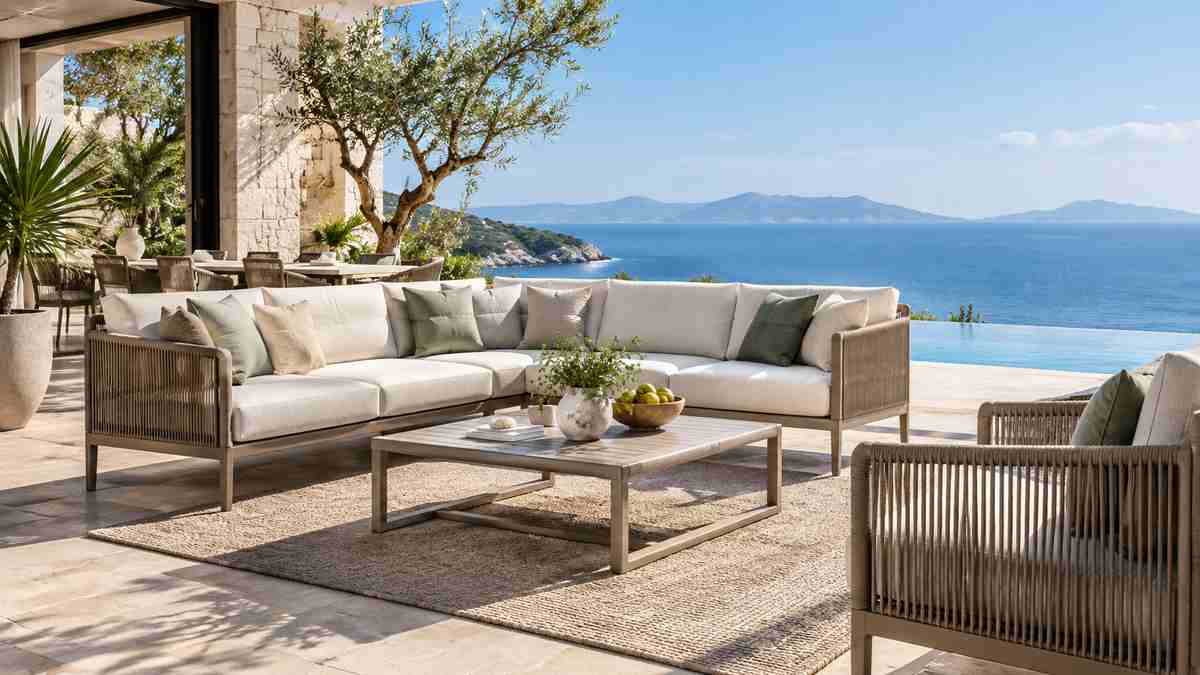
Outdoor rope and PP rattan are frequently used to create woven seating surfaces, backrests and decorative structures.
Both can work effectively in weather resistant outdoor furniture, but buyers should not assume that all rope or synthetic rattan performs equally.
Sun Exposure
UV stabilization and colorfastness are particularly important.
Low-quality woven material may experience color change, brittleness or surface deterioration after long exposure to sunlight.
Buyers should request information about material formulation, UV treatment and available weathering or colorfastness testing.
Rain Exposure
Open rope weaving can allow water and air to pass through the furniture rather than holding moisture against one large surface.
PP rattan is also commonly used outdoors, but very dense weaving can create more areas where dust and moisture accumulate.
The weave should therefore be considered together with frame drainage and accessibility for cleaning.
Rope or PP Rattan?
Saigon Wicker has a dedicated comparison of outdoor rope vs PP rattan covering weaving style, material specification and B2B selection factors.
4. Textilene and Outdoor Mesh: Strong Choices for Rainy and Poolside Areas
Textilene and similar synthetic outdoor mesh materials are especially useful for seating that needs to remain practical after rain or routine cleaning.
The open mesh structure allows air and water to move through the seating surface, which can support faster drying than thick upholstered seating.
Where Textilene Performs Well
Common applications include dining chairs, stackable chairs, poolside loungers and commercial seating.
This makes Textilene particularly relevant for hotels, resorts and restaurants where outdoor furniture must return to service quickly after cleaning or rain.
What Buyers Should Test
UV performance should still be verified. Outdoor textile testing may include colorfastness and weather-resistance methods depending on the required specification.
The AATCC test-method directory includes standards such as TM16.1 for outdoor lightfastness, TM16.3 for xenon-arc lightfastness, TM22 for water repellency and TM35 for rain resistance.
Mesh tension is also important. Excessively loose material can sag, while overly tight construction may reduce comfort or place unnecessary stress on attachment points.
5. Teak and Acacia: Natural Character with More Maintenance Considerations
Wood remains attractive for outdoor collections because it adds warmth and natural texture that is difficult to reproduce with metal alone.
Teak and acacia are commonly considered for outdoor furniture programs, but wood should be evaluated differently from synthetic or metal materials.
Sun Exposure
Wood appearance naturally changes with exposure. Depending on the species, finish and maintenance program, color may gradually weather over time.
Buyers should therefore define whether the desired result is a maintained original tone or a more naturally weathered appearance.
Rain and Moisture
Construction details are critical. Drainage, grain orientation, joints, surface finishing and maintenance instructions can influence outdoor performance.
Wood should not be treated as a completely maintenance-free material.
Responsible Sourcing
For buyers with responsible sourcing requirements, wood origin is a separate consideration from weather durability. The Forest Stewardship Council furniture guidance explains how FSC-certified timber can support responsible furniture sourcing.
Saigon Wicker can develop selected outdoor products with FSC-certified wood options depending on project requirements.
6. Outdoor Fabrics and Cushions: Sun and Rain Need Separate Specifications
Cushions can significantly improve comfort, but they also introduce additional weather considerations.
For upholstered weather resistant outdoor furniture, the buyer should evaluate the fabric, foam and complete cushion construction separately.
For Strong Sun
Colorfastness and UV performance are key considerations.
AATCC TM16.3 provides a method for assessing textile colorfastness to light using xenon-arc exposure, while outdoor-specific lightfastness methods are also available. Buyers can use relevant testing requirements when creating product specifications rather than relying only on descriptive terms such as “UV resistant.”
For Rain
Water repellency does not automatically mean a cushion is completely waterproof.
AATCC TM22, for example, measures textile resistance to surface wetting using a spray test.
Cushion performance also depends on seams, internal foam, ventilation and drainage.
Where furniture remains outdoors for long periods, removable cushions and clear storage procedures may be more practical than attempting to make every upholstered component permanently exposed to severe weather.
For textile safety requirements, buyers may also specify appropriate certifications such as OEKO-TEX STANDARD 100. This certification relates to testing for harmful substances rather than weather resistance, so the two requirements should not be confused.
7. Cushion-Free Seating Can Simplify Wet-Weather Operation
In some commercial environments, the most practical approach is to reduce loose upholstery altogether.
Rope, Textilene and PP rattan can all be used to create seating surfaces that remain functional without thick cushions.
This can reduce the need for staff to remove and reinstall cushions before and after rain.
However, comfort then depends more heavily on seat geometry, backrest angle and material tension.
Buyers considering this direction can review Saigon Wicker’s guide to cushion-free outdoor furniture.
Which Weather Resistant Outdoor Furniture Materials Perform Best?
| Material | Strong Sun | Rain / Humidity | Wind Consideration | Typical B2B Application |
|---|---|---|---|---|
| Powder-Coated Aluminum | Very good with suitable coating | Very good with correct finishing and drainage | Lightweight; complete product stability must be checked | Resorts, retail, cafés, dining and lounge furniture |
| Powder-Coated Steel | Good with appropriate coating | Requires stronger corrosion-control attention | Additional weight can improve normal-use stability | Cafés, dining bases and commercial furniture |
| Outdoor Rope | Depends on UV stabilization and colorfastness | Good with open, quick-draining weaving | Depends mainly on frame and product geometry | Resort, dining and lounge collections |
| PP Rattan | Depends on polymer and UV specification | Generally practical outdoors | Depends on supporting frame | Sofas, dining, bistro and garden furniture |
| Textilene | Good when suitable UV specification is used | Excellent drying potential | Frame stability remains critical | Poolside, sun loungers and commercial dining |
| Teak / Acacia | Good with expected natural weathering | Requires correct construction and maintenance | Heavier components can add mass | Premium resorts and residential collections |
| Outdoor Fabric / Cushions | Depends strongly on colorfastness specification | Depends on fabric, seams, foam and drainage | Loose cushions may need securing or storage | Sofas, daybeds and premium lounge areas |
The table shows why there is no universal “best” material. The strongest weather resistant outdoor furniture normally combines several materials according to the intended climate and usage.
Best Outdoor Furniture for Strong Sun
For intense sunlight, buyers should prioritize materials and finishes with suitable UV and colorfastness specifications.
Powder-coated aluminum is a strong structural option, while rope, PP rattan and outdoor fabrics should be evaluated based on their specific UV stabilization and colorfastness performance.
Color also matters. Very dark or highly saturated surfaces may visually reveal fading differently from neutral or mid-tone finishes.
For textile programs, test methods such as AATCC lightfastness procedures can provide clearer performance criteria than general marketing claims.
Best Outdoor Furniture for Heavy Rain and Humidity
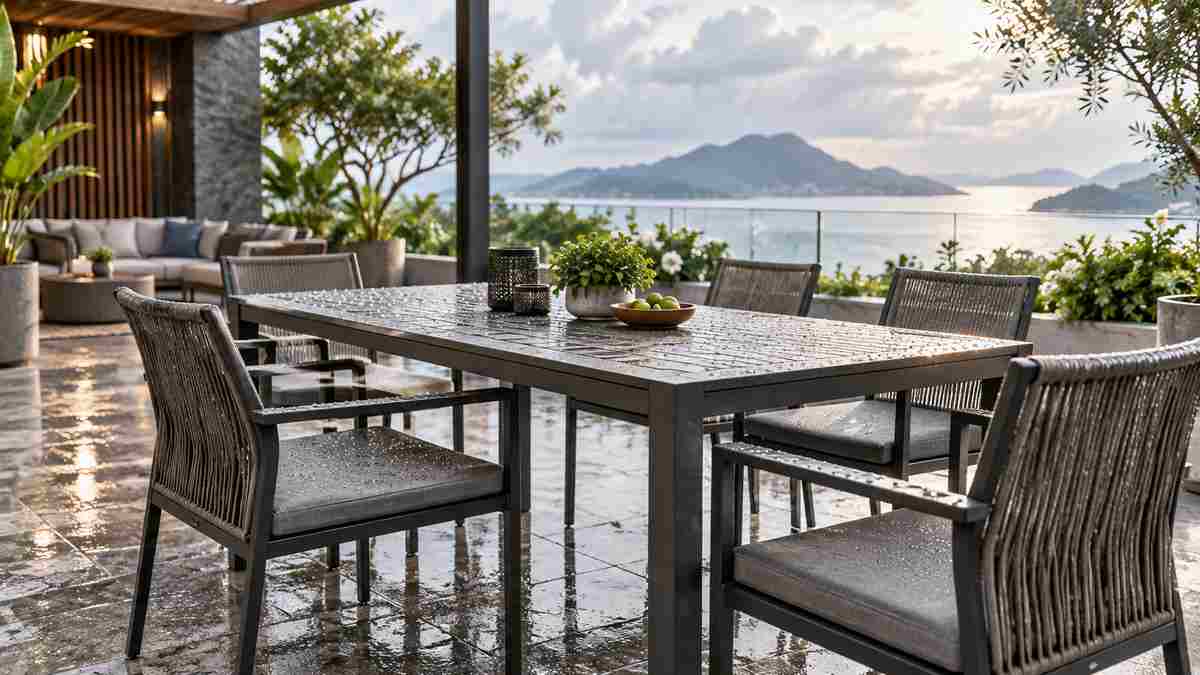
For rainy environments, drainage and drying speed become essential.
Good options can include powder-coated aluminum frames, Textilene seating, open rope structures, synthetic PP rattan and slatted tabletops.
Products should avoid unnecessary horizontal cavities or enclosed areas where water can remain trapped.
Drainage holes, frame ventilation, accessible cleaning areas and quick-drying surfaces can all help improve operational performance.
This is particularly important for hotels and restaurants because furniture that remains wet for long periods can reduce usable seating capacity.
Best Outdoor Furniture for Windy Areas
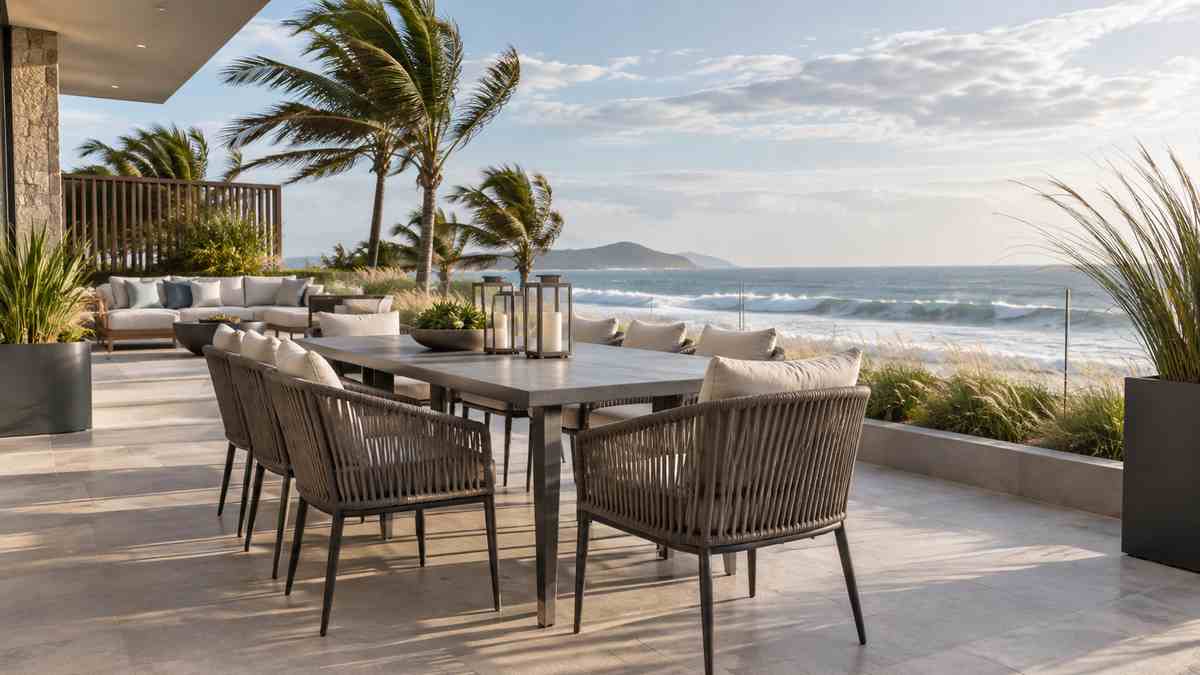
Wind performance should be treated as a complete product-design issue rather than a simple material comparison.
A heavy product is not automatically wind-safe, and a lightweight product is not automatically unsuitable.
Buyers should evaluate:
- Overall furniture weight
- Center of gravity
- Footprint and leg position
- Backrest and tabletop surface area
- Stacking or storage strategy
- Loose cushions and accessories
- Project-specific anchoring requirements where applicable
In severe storms or extreme wind conditions, furniture should be secured or stored according to the site’s operational and safety procedures.
What About Coastal and Poolside Outdoor Furniture?
Coastal and poolside projects require extra attention because salt, chlorides, moisture and frequent cleaning can create more demanding conditions.
For coated aluminum, buyers should discuss pretreatment, powder coating specification, drainage and protection of machined areas with the manufacturer.
QUALICOAT specifically identifies coastal areas and other chloride-heavy environments as conditions that require greater corrosion-protection consideration.
Poolside upholstery should also prioritize quick drying, accessible cleaning and suitable fabric specifications.
B2B Checklist Before Approving Weather Resistant Outdoor Furniture
Before approving a sample or production specification, buyers should review the complete product rather than judging individual material samples in isolation.
- Confirm the intended climate and project location.
- Specify frame material and coating requirements.
- Request UV or colorfastness information for woven materials and fabrics.
- Review drainage holes and water-trapping areas.
- Inspect welds, joints and hardware.
- Check weaving tension and attachment points.
- Evaluate cushion foam, seams and drying construction.
- Review product weight and stability.
- Consider coastal or poolside exposure separately.
- Approve material colors and physical samples before production.
- Review cleaning and maintenance instructions.
- Confirm export packaging and replacement-part requirements.
Weather Resistant Outdoor Furniture at Saigon Wicker
Saigon Wicker develops outdoor furniture for international importers, distributors, retailers, hospitality projects and sourcing partners.
Our manufacturing capabilities include powder-coated aluminum, steel, outdoor rope, PP rattan, Textilene, wood details and outdoor cushion systems.
Depending on the project, buyers can customize frame colors, weaving materials, cushion fabrics, foam specifications, dimensions, tabletop materials and packaging.
Saigon Wicker also develops OEM/ODM products based on drawings, reference images and customer requirements.
Learn more about Saigon Wicker’s outdoor furniture manufacturing capabilities or explore our outdoor furniture collections.
FAQ: Weather Resistant Outdoor Furniture for B2B Buyers
1. What is the best material for weather resistant outdoor furniture?
There is no single best material for every project. Powder-coated aluminum is highly versatile, while Textilene, outdoor rope, PP rattan, wood and outdoor fabrics can perform well when the correct specification is selected for the intended environment.
2. What outdoor furniture material is best for heavy rain?
Materials that support drainage and quick drying are usually easier to manage in rainy environments. Powder-coated aluminum, Textilene, open rope weaving and suitable synthetic rattan are commonly considered, but the full product construction should also allow water to drain effectively.
3. What outdoor furniture performs best in strong sun?
Metal frames with suitable outdoor coatings can perform well in strong sun, while rope, rattan and fabrics should have appropriate UV and colorfastness specifications. Buyers should request technical information rather than relying only on the term “UV resistant.”
4. Is aluminum outdoor furniture suitable for coastal areas?
Aluminum is widely used for coastal outdoor furniture, but coastal exposure is more demanding because of salt and chlorides. Pretreatment, coating quality, sealed machined areas, drainage and maintenance should therefore be reviewed carefully.
5. Is heavy furniture always better for windy areas?
No. Weight is only one factor. Product geometry, center of gravity, surface area and footprint also affect wind stability. Extremely exposed projects may require dedicated storage or anchoring strategies.
6. How should buyers evaluate outdoor fabrics?
B2B buyers should review colorfastness, water repellency or rain resistance, abrasion requirements, construction, seams and intended cleaning method. Testing standards such as relevant AATCC methods can help create measurable specifications.
7. Can Saigon Wicker customize materials for different climates?
Yes. Material combinations, frame finishes, rope or rattan colors, fabrics, cushion construction, dimensions and other product details can be developed according to customer and project requirements, subject to technical review and production feasibility.
Conclusion: Choose Materials for the Climate, Not Just the Look
The strongest weather resistant outdoor furniture is usually created by combining appropriate materials with good product engineering.
Powder-coated aluminum offers broad versatility. Steel can provide additional weight and rigidity. Outdoor rope and PP rattan create woven design flexibility. Textilene supports fast drying. Wood adds natural character, while outdoor fabrics provide comfort when the correct performance specifications are selected.
For B2B buyers, the most important question is not simply, “Which material lasts longest?”
The better question is: “Which material and construction combination is best suited to the sun, rain, humidity, wind and maintenance conditions of the target market?”
Answering that question early can help reduce product complaints, improve project suitability and create stronger long-term value for the collection.
Develop Weather-Ready Outdoor Furniture with Saigon Wicker
Planning an outdoor furniture collection for resorts, retailers, hospitality projects or international distribution?
Saigon Wicker supports B2B customers with material selection, OEM/ODM development, samples, custom specifications, manufacturing, quality control and export packaging.
Contact Saigon Wicker to discuss your outdoor furniture project →