
Ceramic, Stone-Look or Aluminum? Outdoor Table Top Materials Trending in 2027
Outdoor tables are becoming much more than supporting pieces in a furniture collection. For importers, wholesalers, retailers and hospitality buyers, the choice of outdoor table top materials can influence product positioning, maintenance expectations, shipping requirements and even the perceived value of an entire collection.
Ceramic and stone-inspired surfaces are bringing a more architectural look outdoors, while powder-coated aluminum continues to provide practical advantages for commercial and residential furniture. At the same time, mixed-material designs are creating new opportunities for manufacturers and buyers to differentiate products without completely redesigning the furniture structure.
This guide compares the most relevant outdoor table top materials for upcoming collections and explains what B2B buyers should evaluate before approving a table for production.
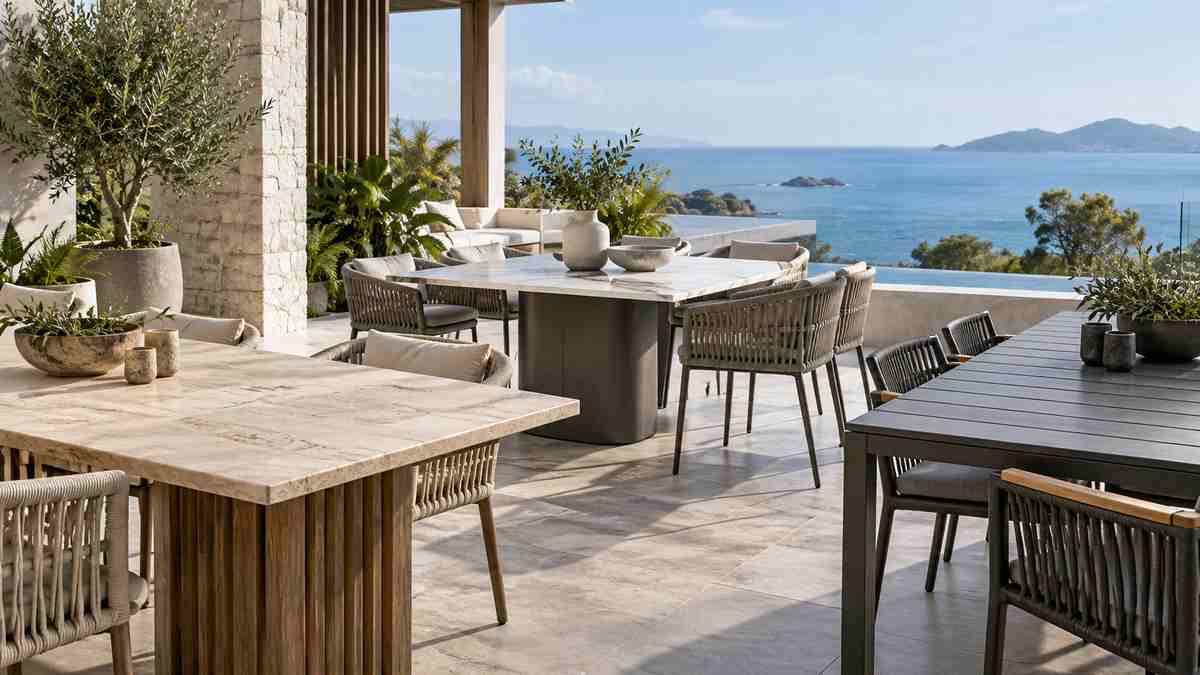
Why Outdoor Table Top Materials Matter More to B2B Buyers
The tabletop is one of the largest visible surfaces in an outdoor dining or lounge collection. Changing this single component can significantly change how the complete product is perceived.
A light stone-look surface paired with a warm beige aluminum frame can create a relaxed resort aesthetic. The same table structure with a charcoal slatted aluminum top can become more architectural and commercial.
For B2B buyers, selecting the right outdoor table top materials therefore affects more than design. It can influence:
- Target retail price
- Product weight
- Container loading efficiency
- Packaging requirements
- Maintenance expectations
- Replacement strategy
- Hospitality suitability
- Overall collection positioning
This is particularly relevant as outdoor furniture continues to borrow visual cues from interior design. Industry observations for 2026 point toward ceramic, sintered stone, mixed materials and refined matte finishes becoming increasingly visible in outdoor collections.
Buyers can also review Saigon Wicker’s guide to round outdoor dining tables for additional considerations related to table shape, circulation and social interaction.
1. Ceramic Outdoor Table Tops Are Moving Upmarket
Ceramic is becoming one of the most design-oriented outdoor table top materials for premium residential and hospitality collections.
Modern ceramic surfaces can reproduce marble, limestone, travertine, concrete and other natural textures while maintaining a more controlled and repeatable visual appearance than many natural materials.
Why Ceramic Appeals to B2B Buyers
For furniture buyers, the main commercial advantage of ceramic is its ability to immediately change the perceived positioning of a table.
A relatively minimal aluminum base can feel significantly more premium when combined with a thin stone-inspired ceramic surface.
This makes ceramic particularly relevant for:
- Luxury outdoor dining collections
- Hotel terraces
- Resort restaurants
- High-end residential retailers
- Architectural outdoor projects
- Premium garden furniture ranges
Ceramic and sintered-stone tabletops are also appearing more frequently in current outdoor furniture development. Industry trend reporting has highlighted their growing role alongside powder-coated aluminum and mixed-material construction.
For additional industry context, see this overview of 2026 outdoor furniture material trends.
What Buyers Should Confirm Before Ordering
Ceramic should not be selected from appearance alone. Buyers should evaluate the complete table construction.
Important points include:
- Surface thickness
- Edge finishing
- Supporting frame configuration
- Attachment method
- Table stability
- Packaging protection
- Replacement possibilities
The supporting structure must match the weight and dimensions of the selected tabletop.
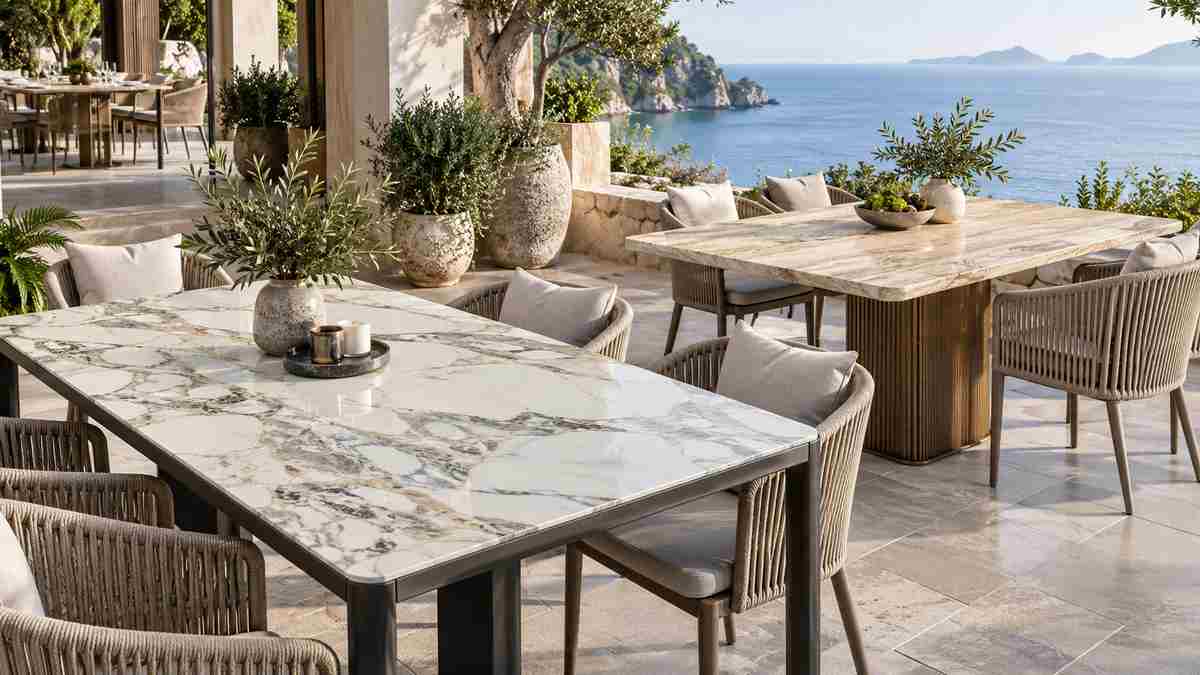
2. Stone-Look Outdoor Table Tops Create Architectural Character
Natural stone has long been associated with premium architecture, but its weight, consistency and handling requirements may not suit every furniture program.
Stone-look surfaces provide another direction within modern outdoor table top materials.
Depending on the technology and material selected, manufacturers can reproduce visual effects inspired by:
- Travertine
- Limestone
- Concrete
- Marble
- Granite
- Soft mineral textures
Why Stone-Look Designs Work Outdoors
Outdoor architecture already uses concrete, landscaping stone, timber, metal and greenery. Stone-inspired surfaces can help furniture connect naturally with these environments.
For resort and hospitality projects, this can make the furniture feel more integrated with the architecture instead of looking like a temporary addition.
Current combinations that work particularly well include stone-look tabletops with bronze taupe, warm beige, charcoal grey and muted green furniture palettes.
3. Aluminum Outdoor Table Tops Remain a Commercial Favorite
While ceramic receives attention for premium design, aluminum remains one of the most practical outdoor table top materials for large-volume outdoor furniture programs.
Powder-coated aluminum offers a useful combination of relatively low weight, manufacturing flexibility and contemporary appearance.
Saigon Wicker already uses aluminum extensively across its outdoor furniture collections. For example, the URBAN outdoor dining set combines powder-coated aluminum structures with a slatted table design.
Why Slatted Aluminum Works Outdoors
A slatted tabletop allows water to pass through controlled gaps rather than remaining across one continuous surface.
That can be useful for patios, cafés, poolside areas and hospitality environments where furniture is frequently exposed to rain or cleaning.
Aluminum tables can also be easier for staff to reposition compared with heavier stone-based alternatives.
Powder Coating Quality Still Matters
The fact that a table is aluminum does not automatically guarantee long-term outdoor performance. Alloy quality, surface preparation, coating process and environmental exposure all influence results.
For buyers evaluating coated aluminum products, QUALICOAT technical information provides useful reference material on coating quality and corrosion protection.
Coastal environments deserve particular attention because salt and moisture create more demanding conditions for coated metal surfaces.
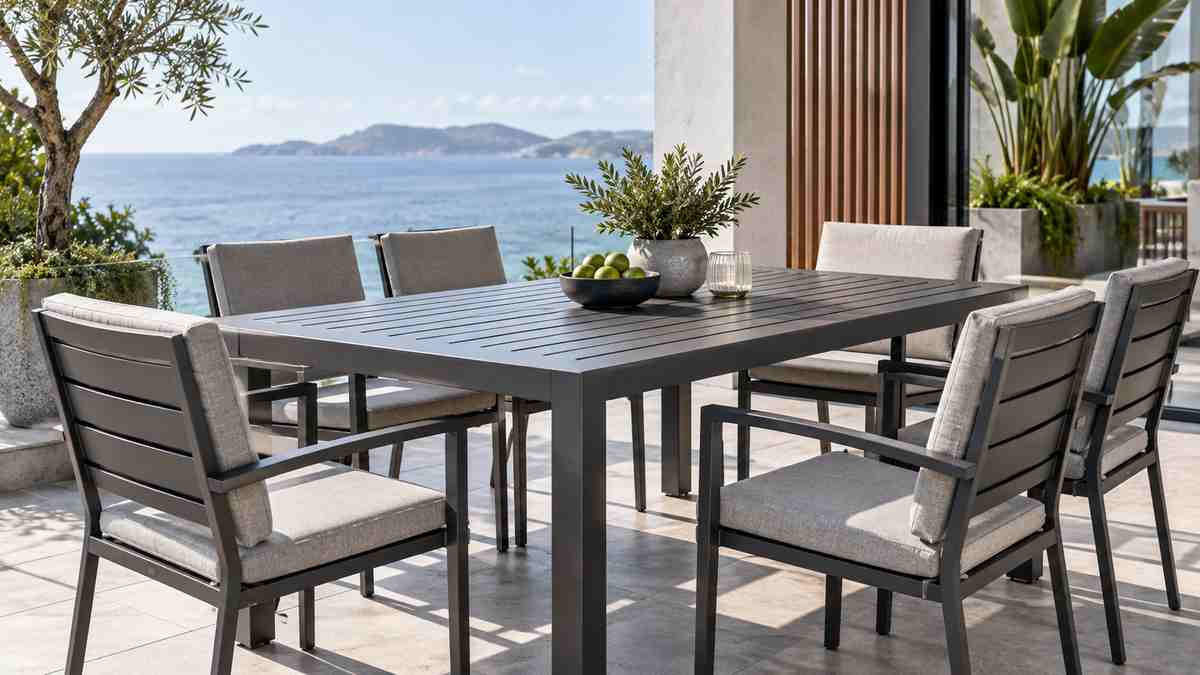
4. Mixed Materials Are Becoming More Important
One of the strongest changes in outdoor furniture is the move away from making every component in exactly the same material and finish.
Instead, designers are increasingly using contrast deliberately.
Examples include:
- Aluminum base + ceramic tabletop
- Charcoal frame + light stone-look top
- Beige aluminum + travertine-inspired surface
- Rope dining chairs + ceramic dining table
- Wood-look aluminum + powder-coated metal
This direction has also been observed by furniture industry publications, where mixed-material design continues to feature in current outdoor collections.
See Furniture Today’s outdoor furniture trend coverage for additional market context.
For importers and retailers, mixed outdoor table top materials also provide a practical merchandising opportunity. A common frame platform can potentially support several tabletop directions for different markets or price levels.
5. Matte and Natural-Looking Finishes Are Replacing Excessive Gloss
Material selection is only part of the decision. Finish is increasingly important.
Outdoor furniture is moving toward softer, more architectural surfaces such as:
- Warm limestone beige
- Soft grey mineral finishes
- Light travertine effects
- Fine-grain charcoal aluminum
- Muted bronze
- Natural wood-inspired aluminum
These finishes coordinate well with rope, PP rattan and neutral outdoor upholstery.
They can also help a collection work across residential, retail and hospitality environments without appearing overly decorative.
6. The Best Outdoor Table Top Materials Depend on Commercial Use
For a retail photograph, almost any tabletop can look attractive. Commercial buyers need to look further.
The best outdoor table top materials depend on how frequently the furniture will be moved, cleaned and used.
Restaurants and Cafés
Frequent cleaning and layout changes make weight, surface accessibility and maintenance particularly important.
Aluminum may be attractive for cafés requiring furniture to be repositioned regularly, while ceramic can support more premium restaurant positioning.
Hotels and Resorts
Hospitality projects often place greater emphasis on visual identity and integration with architecture. Ceramic and stone-inspired surfaces can therefore work particularly well in premium dining and lounge environments.
Residential Retail
Retail collections usually need to balance appearance, cost, packaging size and consumer-friendly maintenance.
This means there is room for all three directions depending on target price point.
7. Tabletop Trends Must Also Work for Export
A B2B product is not finished when the prototype looks good. It also has to survive packing, warehousing, container loading and international transportation.
That makes export considerations particularly important when selecting outdoor table top materials.
Consider Weight
Heavier surfaces can influence carton handling, container payload and installation requirements.
Protect the Edges
Rigid ceramic and stone-inspired surfaces require suitable edge and corner protection.
Evaluate Knock-Down Construction
Where practical, removable table legs or base structures can help improve carton efficiency.
Plan for Replacement
Hospitality buyers may benefit from a design that allows a damaged tabletop to be replaced without replacing the entire table.
Ceramic vs Stone-Look vs Aluminum Outdoor Table Top Materials
| Buying Factor | Ceramic | Stone-Look | Aluminum |
|---|---|---|---|
| Design Positioning | Premium | Architectural / natural | Modern / versatile |
| Relative Weight | Medium to heavy | Depends on construction | Lightweight |
| Handling | Requires more care | Depends on material | Relatively easy |
| Finish Options | High | High | High |
| Maintenance | Generally straightforward | Material dependent | Generally straightforward |
| Hospitality Potential | Excellent for premium areas | Excellent for architectural projects | Excellent for high-frequency use |
| Export Packaging | Needs careful protection | Depends on construction | Generally simpler |
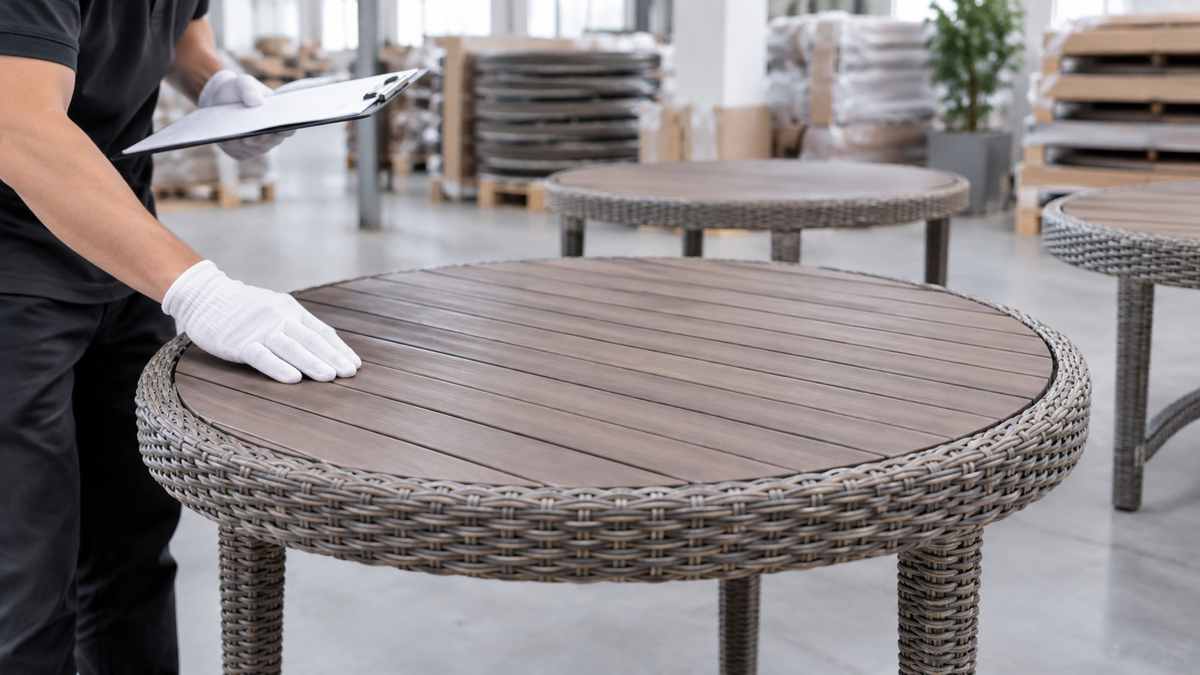
B2B Checklist Before Approving Outdoor Table Top Materials
Before approving a sample for mass production, buyers should review the tabletop together with the complete table structure.
- Confirm tabletop dimensions and thickness.
- Check surface color and finish consistency.
- Review edge treatment and corners.
- Confirm frame support under the tabletop.
- Check table balance and stability.
- Review attachment points.
- Consider drainage where necessary.
- Evaluate total product weight.
- Review KD assembly requirements.
- Confirm carton and protective packaging.
- Consider replacement-part requirements.
- Approve the physical sample before mass production.
For buyers looking for a manufacturing partner with integrated quality management, see why international buyers work with Saigon Wicker.
Outdoor Table Development at Saigon Wicker
Saigon Wicker manufactures outdoor furniture for international importers, wholesalers, retailers and hospitality partners.
Our current capabilities include powder-coated aluminum structures, slatted aluminum table surfaces, heat-transfer wood-look aluminum and wood options depending on product requirements.
For example, the URBAN round dining collection and OCEAN dining collection demonstrate how table structures can be developed with different finishes and material combinations.
When evaluating new outdoor table top materials, our development process can consider tabletop dimensions, frame design, finish direction, packaging and the requirements of the customer’s target market.
Learn more about Saigon Wicker’s outdoor furniture manufacturing capabilities in Vietnam.
FAQ: Outdoor Table Top Materials for B2B Buyers
1. What are the best outdoor table top materials for commercial furniture?
The best material depends on the application. Aluminum is practical when lightweight construction and frequent handling are priorities. Ceramic can support premium positioning, while stone-look surfaces can create a more architectural appearance.
2. Is ceramic suitable for outdoor dining tables?
Suitable ceramic products can be used for outdoor tables, but buyers should verify the specific material specification, supporting frame, edge construction and intended outdoor application before ordering.
3. Are aluminum table tops suitable for resorts?
Yes. Powder-coated aluminum can work well in resorts, cafés, restaurants and poolside environments, particularly where lightweight handling and contemporary design are important. The coating system and environmental conditions should still be considered.
4. Is stone-look better than natural stone for outdoor furniture?
Neither is automatically better. Stone-look surfaces can provide a natural visual effect while offering different options for weight, consistency and manufacturing. Natural stone may provide a distinctive premium character but can introduce additional handling considerations.
5. Can buyers customize outdoor table top materials and colors?
Customization depends on the product, material supplier, MOQ and manufacturing requirements. Options may include dimensions, frame colors, tabletop finishes and surface patterns.
6. What should importers inspect before approving an outdoor table sample?
Importers should check dimensions, tabletop support, stability, finish consistency, edge quality, assembly, product weight and packaging. Physical sample approval is recommended before mass production.
7. Can the same table frame use different tabletop materials?
Potentially, yes. However, each material has different weight and structural requirements. The supporting frame should therefore be reviewed and tested for every approved tabletop option.
Conclusion: Outdoor Table Top Materials Are Becoming More Diverse
There is no single tabletop material replacing every other option.
Instead, the market is moving toward more deliberate material selection.
Ceramic provides a refined, premium appearance. Stone-inspired surfaces bring architectural texture. Aluminum remains relevant for lightweight, practical and commercially flexible collections.
For B2B buyers, the strongest outdoor table top materials are therefore the ones that match the intended market, price position, operating environment, packaging requirements and complete furniture design.
The objective should not simply be to follow a material trend. It should be to choose a surface that makes commercial sense throughout the product lifecycle.
Develop Your Next Outdoor Table Collection with Saigon Wicker
Planning a new outdoor dining, coffee table or hospitality collection?
Saigon Wicker supports international B2B customers with OEM/ODM development, customized specifications, material selection, samples, manufacturing, quality control and export coordination.
Contact Saigon Wicker for your next B2B outdoor furniture project →