
A heavy chair with a narrow footprint and large solid back can still become unstable. A lighter chair with a low profile, broad stance and open construction may behave very differently under the same conditions.
This guide explains the most important design and sourcing factors B2B buyers should evaluate when developing outdoor furniture for windy areas.
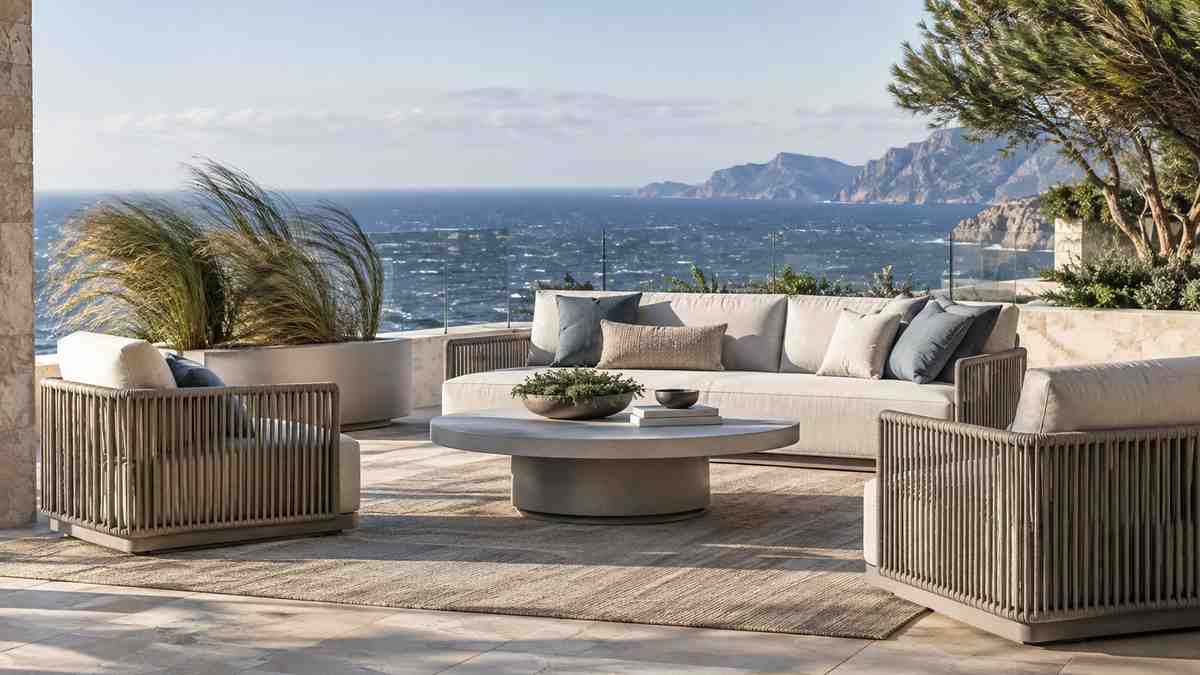
Why Outdoor Furniture for Windy Areas Needs a Different Approach
Wind creates forces that normal showroom testing cannot demonstrate visually.
Large flat backs, tabletops, side panels and loose cushions can present significant surface area to moving air. At the same time, tall furniture creates greater leverage around its base than low-profile furniture.
This means outdoor furniture for windy areas should be evaluated as a complete structure rather than by frame material alone.
Important factors include:
- Total product weight
- Weight distribution
- Center of gravity
- Base footprint
- Furniture height
- Surface area facing the wind
- Open or closed construction
- Frame rigidity
- Joint quality
- Cushion attachment
- Site exposure
Mechanical stability is also an established furniture-safety consideration. Current BS EN 581-2:2026 addresses safety, strength, reliability and stability for outdoor seating, while BS EN 581-3:2026 covers outdoor tables.
These standards should not be interpreted as a guarantee that a piece of furniture is safe in any wind speed. Project conditions still need to be considered separately.
1. Weight Matters — But Heavier Is Not Automatically Better
Weight is usually the first characteristic buyers consider when specifying outdoor furniture for windy areas.
In general, a heavier object requires more force to slide, lift or overturn than a comparable lighter object.
This can give steel, dense hardwood, large table bases and heavier construction an advantage in exposed spaces.
However, weight should never be used as the only selection criterion.
Why Weight Alone Can Be Misleading
Imagine two outdoor chairs of similar weight.
One has a tall solid back and narrow legs. The other has a lower back, wider footprint and open rope construction.
The first chair presents more surface to the wind and creates greater leverage above its base. As a result, its additional mass may not provide the stability buyers expect.
The better sourcing question is therefore not:
“How heavy is the chair?”
It is:
“How is the weight distributed through the complete chair?”
2. A Low Center of Gravity Can Improve Stability
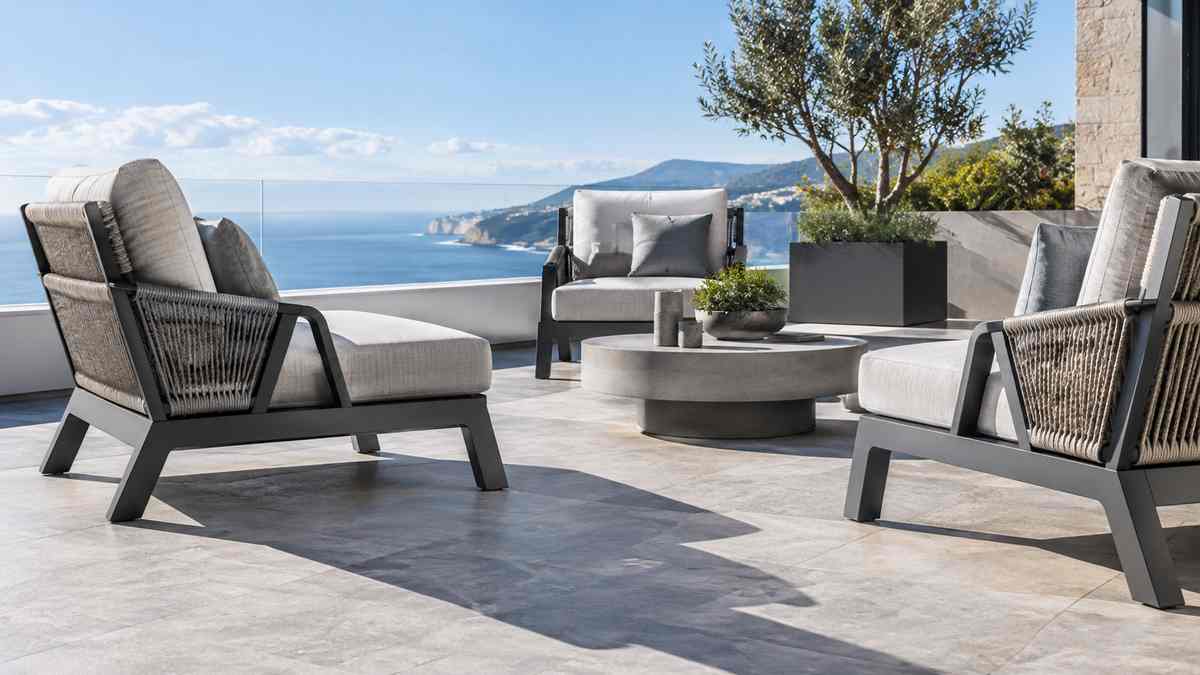
Low-profile sofas, lounge chairs and daybeds often have an inherent geometric advantage over tall bar stools or narrow high-back chairs.
The closer the furniture mass is to the floor, the more difficult it generally becomes to rotate the product around its contact points.
This makes center of gravity particularly important when developing outdoor furniture for windy areas such as:
- Oceanfront resorts
- Rooftop lounges
- High-rise balconies
- Open pool decks
- Golf clubs
- Elevated restaurant terraces
For lounge collections, lower seat heights and wider furniture proportions can provide both a relaxed visual character and a more grounded structure.
3. Wide and Stable Bases Matter as Much as Weight
Base geometry determines how far a product can tilt before its center of mass moves beyond its support area.
For this reason, wider furniture footprints can provide useful stability advantages.
Buyers should inspect:
- Distance between furniture legs
- Front-to-back footprint
- Side-to-side footprint
- Leg angle
- Floor contact points
- Adjustable feet or glides
- Pedestal-base dimensions
A narrow central pedestal may look minimal and elegant, but it should be evaluated carefully for exposed commercial locations.
For dining chairs and lounge seating, four well-positioned legs or an appropriately engineered base can create more predictable support.
4. Open, Slatted and Mesh Designs Reduce Large Wind-Catching Surfaces
One of the most useful design strategies for outdoor furniture for windy areas is reducing uninterrupted surface area.
Open designs allow some airflow to pass through the product rather than acting against one continuous panel.
Useful Design Directions
- Slatted aluminum tabletops
- Slatted wood or wood-look surfaces
- Open rope backrests
- PP rattan weaving
- Textilene mesh
- Perforated surfaces
- Open-frame armrests
This does not make furniture “windproof,” but it can reduce the amount of solid area presented directly to airflow.
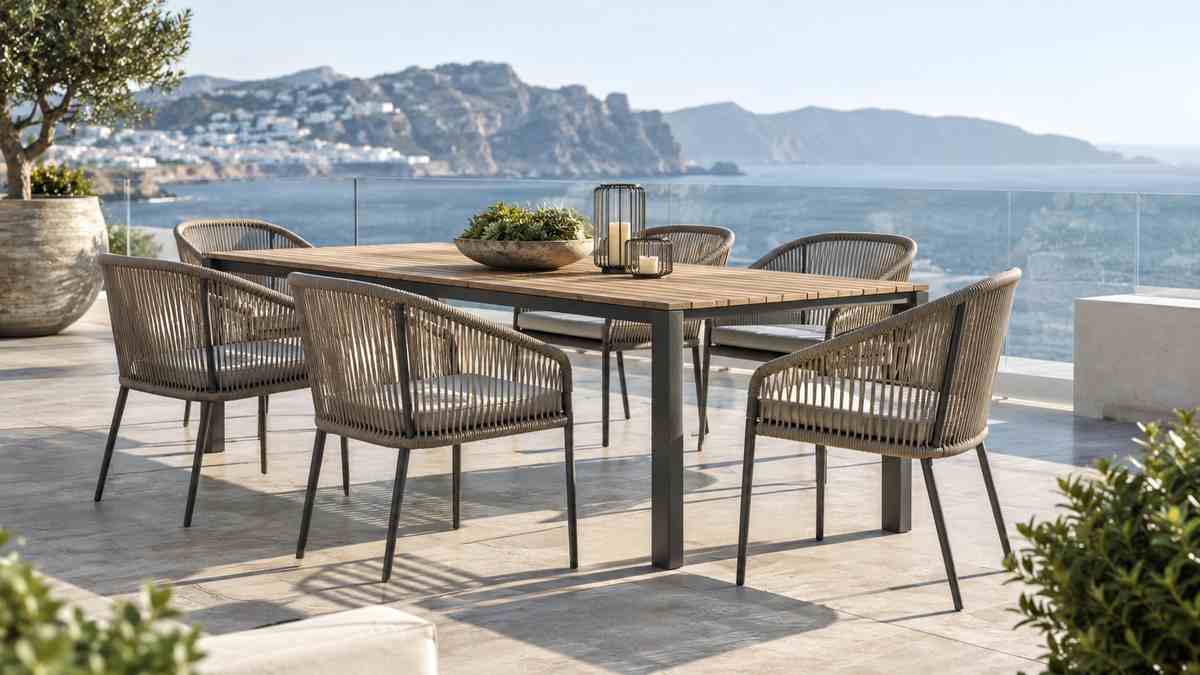
Saigon Wicker’s SIARGAO aluminum Textilene dining set, for example, uses breathable mesh seating and slatted construction rather than large solid seating panels.
The DERAWAN outdoor dining collection also uses slatted seating and tabletop structures that create a more open architectural form.
5. Which Materials Work Best for Outdoor Furniture for Windy Areas?
No frame material automatically guarantees good wind stability.
The appropriate choice depends on product geometry, required mobility, corrosion conditions and project operation.
Powder-Coated Aluminum
Aluminum is one of the most common materials used in modern outdoor furniture because it is relatively lightweight, corrosion resistant and highly flexible for manufacturing.
Its lower weight can be an advantage for restaurants and hotels that frequently rearrange furniture.
For highly exposed locations, however, lightweight aluminum products should be designed with sufficient frame dimensions, stable geometry and an appropriate footprint.
Aluminum works especially well when combined with open rope, Textilene or slatted construction.
Steel
Steel provides additional mass compared with many aluminum structures.
This can be useful when a project requires heavier furniture, but corrosion protection becomes particularly important outdoors.
Powder coating, protected welds, proper drainage and suitable hardware should all be reviewed.
Teak and Other Dense Woods
Wood can provide useful mass and a naturally substantial feel.
Teak and selected hardwoods are frequently specified for premium outdoor projects where buyers want both natural character and a heavier product.
However, wood requires appropriate construction and maintenance, especially in changing weather conditions.
Outdoor Rope and PP Rattan
These materials do not determine stability by themselves because they are normally supported by a metal frame.
Their advantage is that open weaving can reduce large continuous surfaces.
Buyers comparing woven options can read Saigon Wicker’s guide to outdoor rope vs PP rattan.
Textilene
Textilene can be useful for dining chairs and loungers because the mesh surface allows airflow through the seat and backrest.
It can also eliminate thick loose back cushions on selected products, simplifying outdoor operation.
6. Frame Strength, Joints and Hardware Should Not Be Overlooked
Furniture stability is not only about preventing tipping.
Repeated movement, vibration and exposure can also place stress on joints and connection points.
When sourcing outdoor furniture for windy areas, buyers should inspect:
- Weld consistency
- Frame alignment
- Cross-bracing where required
- Bolted connection points
- Fastener material
- Leg rigidity
- Table base connections
- KD assembly systems
Stainless steel screws and suitable outdoor hardware can be useful for exposed furniture, but hardware should always be selected together with the surrounding frame material and environmental conditions.
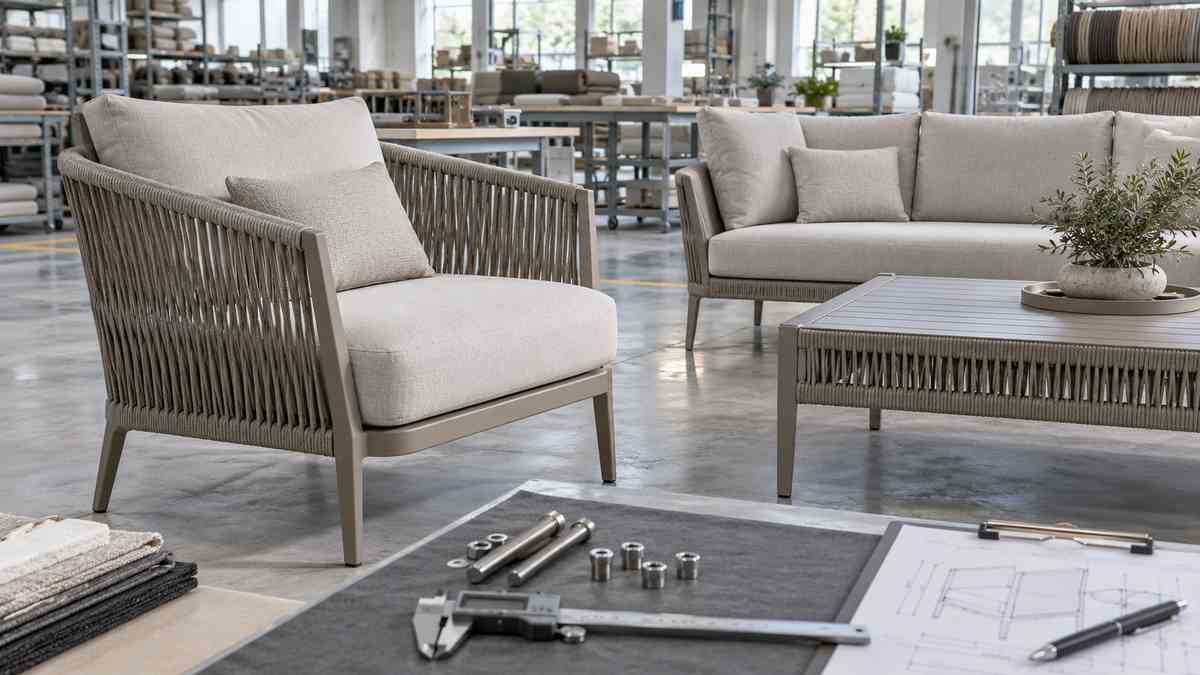
For B2B production, these points should be included in sample approval and quality-control procedures rather than checked only after shipment.
7. Cushions Can Become the Weakest Point in Windy Conditions
A sofa frame may remain stable while its cushions move long before the furniture itself.
Loose seat pads, decorative pillows and back cushions add large lightweight surfaces that can be affected by sudden gusts.
For outdoor furniture for windy areas, buyers should consider:
- Velcro attachment
- Hidden ties
- Anti-slip cushion bases
- Close-fitting cushion dimensions
- Removable cushions for storage
- Reduced decorative pillow quantities
Hospitality operators should also have a practical procedure for removing loose textiles when severe weather is expected.
This is particularly important for rooftop and coastal projects where wind conditions can change quickly.
8. Tables Need Special Attention Because Tabletops Create Large Surface Areas
Dining and coffee tables can present considerably more horizontal surface area than chairs.
For exposed areas, the tabletop and base should therefore be evaluated together.
Slatted Tabletops
Slatted aluminum or wood-look aluminum surfaces create gaps between individual sections. They can also support drainage after rain.
This makes slatted construction a useful direction for exposed outdoor dining furniture.
Solid Tabletops
Ceramic, glass and other continuous surfaces may provide premium visual character but should be matched with an appropriately engineered base.
Buyers should consider tabletop dimensions, weight, attachment method and base width rather than evaluating the tabletop separately.
Pedestal Tables
Central pedestal designs should be checked carefully because base diameter, base weight and table height strongly influence stability.
A premium appearance should never replace structural evaluation.
9. No Outdoor Furniture Should Be Treated as Storm-Proof
This is one of the most important points for project buyers.
Even carefully selected outdoor furniture for windy areas should not be marketed or operated as though it can remain unsecured during every severe wind event.
The U.S. National Weather Service advises people to secure outdoor items such as patio furniture when strong winds are forecast because loose objects can become airborne and dangerous.
See the National Weather Service wind safety guidance for general high-wind precautions.
Hospitality projects should therefore establish a high-wind operating procedure that may include:
- Moving lightweight furniture into storage
- Stacking compatible chairs
- Connecting modular components where designed for this purpose
- Removing cushions and accessories
- Closing and securing umbrellas
- Using project-approved anchoring or ballast systems where appropriate
Any permanent anchoring method should be assessed for the specific project, floor construction, local requirements and furniture design.
Best Outdoor Furniture for Windy Areas by Project Type
| Project | Recommended Design Direction | Main Consideration |
|---|---|---|
| Beachfront Resort | Low-profile aluminum or heavier frames with open rope/Textilene | Wind plus salt exposure |
| Rooftop Restaurant | Stable dining chairs, wide-base tables, reduced solid surface area | Highly exposed airflow |
| Hotel Pool Deck | Low loungers, Textilene seating, secure cushions | Wind, moisture and frequent movement |
| High-Rise Balcony | Compact, low-profile furniture with controlled loose components | Limited space and elevation |
| Open Garden | Aluminum, steel, wood or woven collections with stable geometry | Local exposure determines requirements |
| Café Terrace | Stackable yet structurally stable chairs with practical storage plan | Operational flexibility |
B2B Checklist Before Ordering Outdoor Furniture for Windy Areas
For importers, project buyers and hospitality procurement teams, wind requirements should be discussed during product development rather than after installation.
Before approving outdoor furniture for windy areas, review the following:
- Where will the furniture be installed?
- Is the site sheltered, coastal, elevated or fully exposed?
- What is the total product weight?
- Where is the weight concentrated?
- How wide is the furniture footprint?
- Is the product low-profile or top-heavy?
- Does the backrest contain large solid panels?
- Is the tabletop solid, slatted or perforated?
- How rigid are the legs and frame connections?
- Are loose cushions secured?
- Can chairs be stacked or stored quickly?
- Does the project require a dedicated anchoring solution?
- Which mechanical stability requirements apply to the target market?
- Has the physical sample been inspected before mass production?
For European-market projects, buyers may also review applicable requirements under the EN 581 family of outdoor furniture standards when preparing specifications.
Developing Stable Outdoor Furniture with Saigon Wicker
Saigon Wicker manufactures outdoor furniture for international importers, wholesalers, retailers, hospitality projects and sourcing partners.
Depending on the project, product development can include powder-coated aluminum or steel structures, outdoor rope, PP rattan, Textilene, wood components and outdoor cushions.
For outdoor furniture for windy areas, buyers can discuss factors such as:
- Frame construction
- Product dimensions
- Base geometry
- Seat and backrest profiles
- Slatted or open surfaces
- Furniture weight
- Cushion attachment
- KD or welded structures
- Material combinations
- Packaging and project requirements
Saigon Wicker’s URBAN outdoor rope sofa collection demonstrates how powder-coated aluminum, open rope construction and slatted table surfaces can be combined within a contemporary hospitality collection.
Learn more about Saigon Wicker’s manufacturing capabilities and why B2B buyers work with Saigon Wicker.
FAQ: Outdoor Furniture for Windy Areas
1. What is the best outdoor furniture for windy areas?
The best furniture depends on the site, but buyers should generally look for sufficient weight, a low center of gravity, a wide stable base and construction that avoids unnecessary large solid surfaces. Product-level stability is more important than frame material alone.
2. Is heavy outdoor furniture always better in strong wind?
No. Additional weight can improve resistance to movement, but tall furniture with narrow bases or large solid surfaces may still become unstable. Weight should be evaluated together with center of gravity, geometry and surface area.
3. Is aluminum outdoor furniture suitable for windy areas?
Yes, depending on the product design. Aluminum can be suitable when frame dimensions, footprint and geometry provide sufficient stability. Lightweight aluminum pieces may require additional operational controls in highly exposed areas.
4. Are slatted tables better for windy terraces?
Slatted surfaces reduce continuous solid surface area and can allow some airflow between the slats. They can be a useful design direction for exposed projects, but the complete table base and structure must still be stable.
5. What type of outdoor chair works well on windy rooftops?
Buyers should consider chairs with a relatively low profile, stable footprint, rigid frame and open back construction such as rope, slats or Textilene. Project-specific exposure should still be evaluated before installation.
6. How do hotels keep outdoor cushions from blowing away?
Options can include Velcro, concealed ties, anti-slip systems and fitted cushion dimensions. Hotels should also remove loose cushions when severe weather is expected.
7. Can Saigon Wicker customize outdoor furniture for windy projects?
Yes. Product dimensions, frame structures, material combinations, weaving, Textilene, cushion details, finishes and other specifications can be developed according to project requirements, subject to technical review and sample approval.
Conclusion: Stability Is a Design System, Not Just a Weight Specification
Selecting outdoor furniture for windy areas is not simply about ordering the heaviest chair or table available.
Weight matters, but center of gravity, base width, furniture height, surface area, open construction, frame rigidity and cushion management can be equally important.
For B2B buyers, the best approach is to evaluate the complete furniture system in the context of the actual project.
A beachfront resort, rooftop restaurant and sheltered residential patio should not automatically receive the same furniture specification.
And when severe winds are forecast, even well-designed outdoor furniture should be secured or stored according to the site’s safety procedures.
Develop Outdoor Furniture for Exposed Hospitality Projects
Planning furniture for a rooftop terrace, beachfront resort, restaurant, pool deck or other exposed outdoor environment?
Saigon Wicker supports B2B customers with OEM/ODM development, material selection, frame design, custom dimensions, samples, quality control and export production.
Contact Saigon Wicker to discuss your outdoor furniture project →