
For retailers, designers, hospitality buyers, and product-development teams, the opportunity is clear: compact outdoor living needs products designed specifically around smaller spaces rather than simply scaled-down versions of large patio furniture.
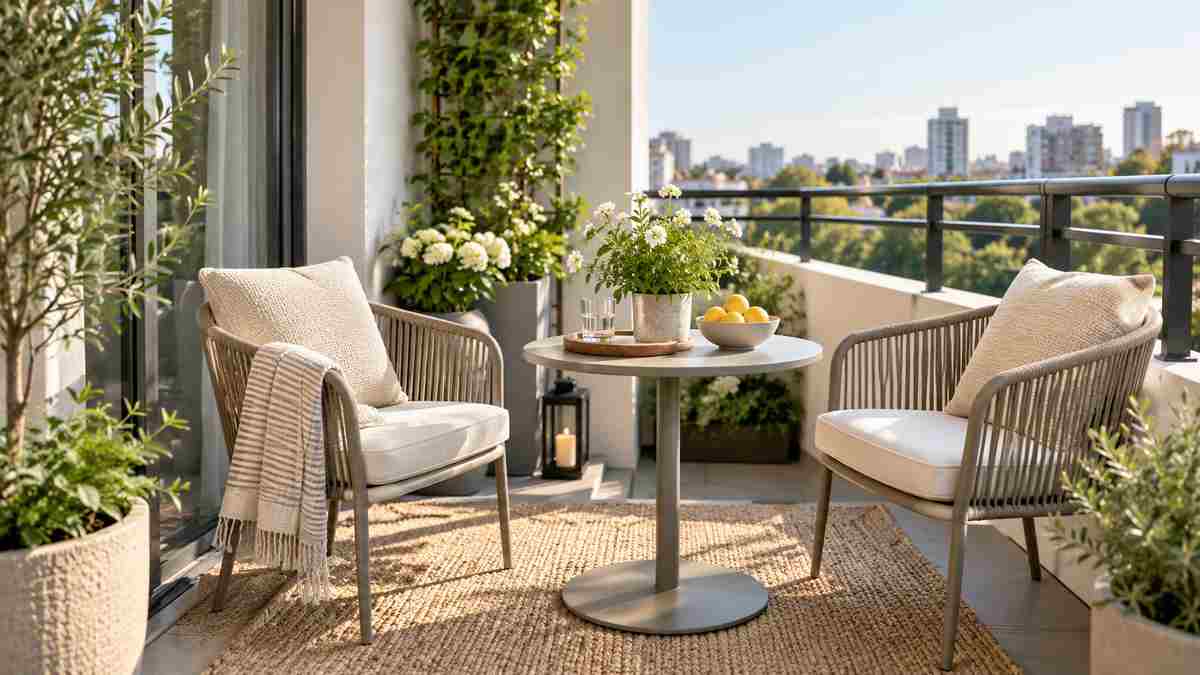
Why Small Space Outdoor Furniture Matters More in 2026–2027
Balconies and compact patios are increasingly being treated as real living spaces rather than leftover outdoor areas.
Current design directions are emphasizing compact proportions, multifunctional furniture, modular pieces, woven textures, natural-looking materials, and outdoor seating that delivers more comfort without taking over the space.
HGTV’s small-space patio furniture guide
also emphasizes the importance of furniture scale when working with limited outdoor areas.
The result is a shift from “How much furniture can fit?” to a better question:
“What furniture makes this small space more useful?”
1. Measure the Usable Space — Not Just the Floor Area
The most important decision happens before choosing a product.
Measure the complete outdoor area, but also identify the space that cannot realistically be occupied by furniture.
Check:
- Door swing
- Sliding-door access
- Walking paths
- Railings
- Drainage points
- Columns
- Air-conditioning units
- Planters
- Storage access
A balcony may technically have enough square meters for a sofa and table, but the usable footprint can become much smaller once circulation is considered.
For small space outdoor furniture, buyers should therefore review actual product dimensions rather than relying on descriptions such as “compact” or “balcony size.”
2. Choose the Right Scale, Not Simply the Smallest Furniture
Furniture that is too large makes a compact patio feel crowded.
But furniture that is too small can also become uncomfortable and visually weak.
The goal is proportional furniture.
Useful details may include:
- Slimmer armrests
- Controlled seat depth
- Narrower table profiles
- Open frame structures
- Elevated legs
- Visually lighter woven surfaces
Open-frame aluminum, rope, or synthetic wicker furniture can help a compact space feel less visually heavy than a large solid structure.
When evaluating small space outdoor furniture, buyers should consider the complete footprint rather than the width of one individual chair or table.
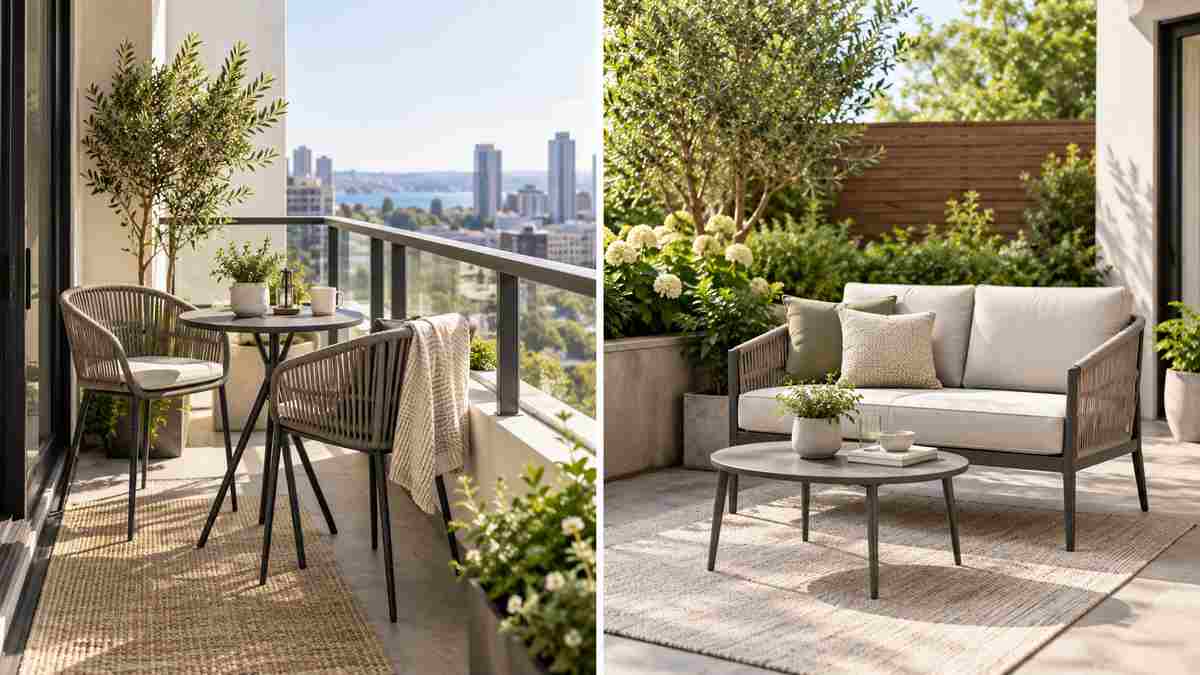
3. Bistro Sets Still Work — When the Proportions Are Right
A two-chair bistro arrangement remains one of the most efficient solutions for small balconies.
It provides a clear function without requiring a large footprint.
A compact set may work well for:
- Morning coffee
- Two-person dining
- Apartment balconies
- Small café terraces
- Guest-room balconies
Round tables can be particularly useful because they reduce sharp corners in narrow circulation areas.
Stackable or lightweight chairs can make the setup even more flexible.
However, the chairs still need enough width and back support to remain comfortable.
Good small space outdoor furniture saves space without making the user feel like comfort has been sacrificed.
4. Use a Loveseat Instead of a Full Outdoor Sofa
Not every small patio needs dining furniture.
For buyers prioritizing relaxation, a compact two-seat sofa or loveseat may create more value than several individual chairs.
A well-proportioned loveseat can provide:
- Comfort for two people
- A stronger lounge feeling
- Fewer separate furniture pieces
- Simpler styling
The key measurements are seat depth and total frame depth.
An oversized deep-seating sofa can quickly dominate a narrow balcony.
For compact residential and hospitality spaces, the product may need to retain comfortable cushion proportions while reducing unnecessary frame depth or oversized armrests.
5. Stackable and Nesting Furniture Earns Its Footprint
Furniture becomes more valuable in a small space when it can temporarily disappear.
This is why stacking and nesting are particularly relevant to small space outdoor furniture.
Useful options include:
- Stackable dining chairs
- Stackable armchairs
- Nesting side tables
- Two-size coffee tables
- Stools that can double as tables
Nesting tables allow buyers to increase surface area when needed and reduce the footprint afterward.
Stackable chairs can help hospitality operators or homeowners recover floor area without needing a separate storage room.
6. Choose Furniture With More Than One Function
Multifunctional furniture makes sense when space is limited.
A product might operate as:
- Ottoman + extra seat
- Stool + side table
- Bench + storage
- Nesting tables + separate side tables
- Modular unit + standalone chair
But multifunctionality should solve a real problem.
A complicated product that is difficult to move or use does not automatically make a small space better.
The strongest solutions are visually simple and easy to reconfigure.
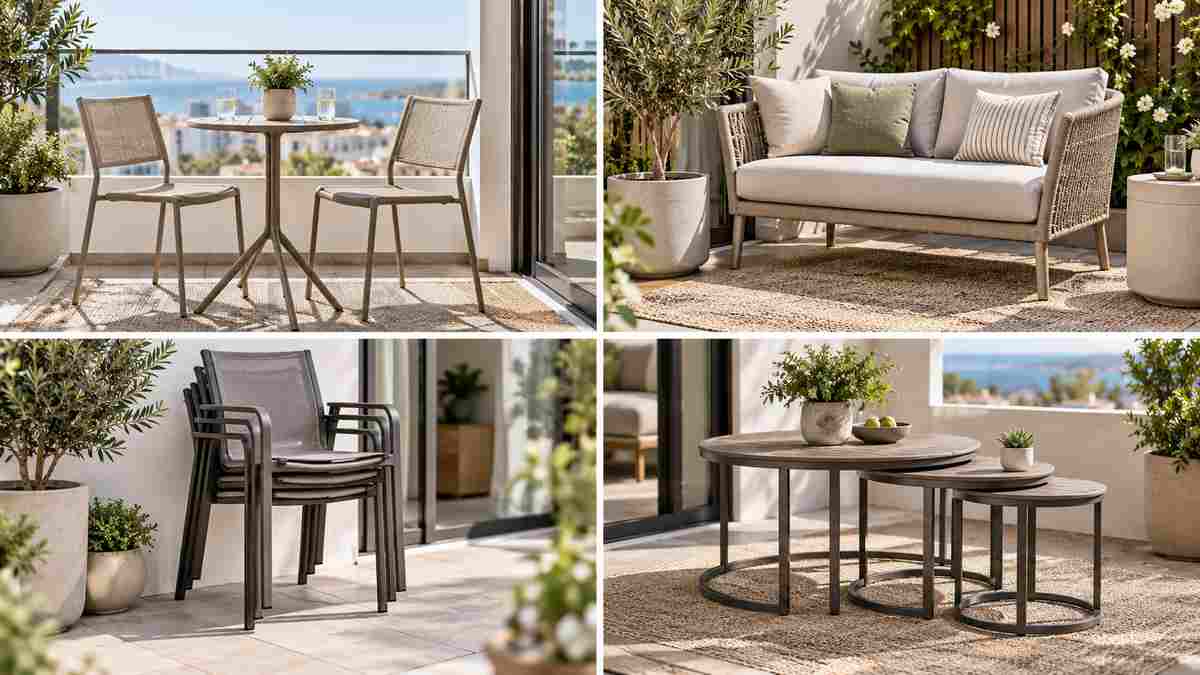
7. Use Materials That Keep the Space Visually Light
Material selection affects more than durability.
It also affects how visually heavy the furniture feels.
For compact spaces, useful material combinations may include:
- Powder-coated aluminum
- Outdoor rope
- PP or PE synthetic wicker
- Textilene
- Wood accents
- Tempered glass
- Light neutral outdoor fabrics
Aluminum can provide a relatively lightweight frame, while rope and woven materials introduce texture without creating a solid visual block.
Wood accents can add warmth without requiring an entire furniture structure to be wooden.
Buyers comparing woven options can also read our
Outdoor Rope vs PP Rattan guide
.
8. Keep the Palette Calm, Then Add One Layer of Personality
Color can influence how spacious a compact outdoor area feels.
For larger furniture surfaces, buyers often work with:
- Ivory
- Warm beige
- Greige
- Light grey
- Sage
- Soft taupe
These shades are easy to coordinate with aluminum, rope, synthetic wicker, and wood.
Personality can then come from smaller elements such as:
- Striped cushions
- Accent pillows
- Textured rope
- A contrasting side table
- Warm wood details
The goal is not to make every small space neutral. It is to keep the larger visual elements controlled so the patio feels intentional rather than crowded.
9. Never Sacrifice Comfort Just to Save Space
Compact furniture still needs to be furniture people want to use.
Before approving small space outdoor furniture, buyers should evaluate:
- Seat width
- Seat depth
- Seat height
- Backrest angle
- Armrest position
- Cushion thickness
- Table height
- Legroom
Reducing a chair by a few centimeters may improve fit, but reducing the wrong dimension can negatively affect comfort.
This is particularly important for hospitality projects, where uncomfortable balcony furniture can reduce how much guests actually use the outdoor space.
Three Small Outdoor Layouts That Work
Layout A — Small Balcony
2 compact chairs + 1 round side or bistro table.
Best for coffee, conversation, and guest-room balconies.
Layout B — Compact Patio Lounge
1 two-seat loveseat + 1 armchair + nesting tables.
Best for a more comfortable residential-style lounge.
Layout C — Flexible Terrace
2–4 stackable chairs + compact dining table.
Best where the space needs to change between dining and open-floor use.
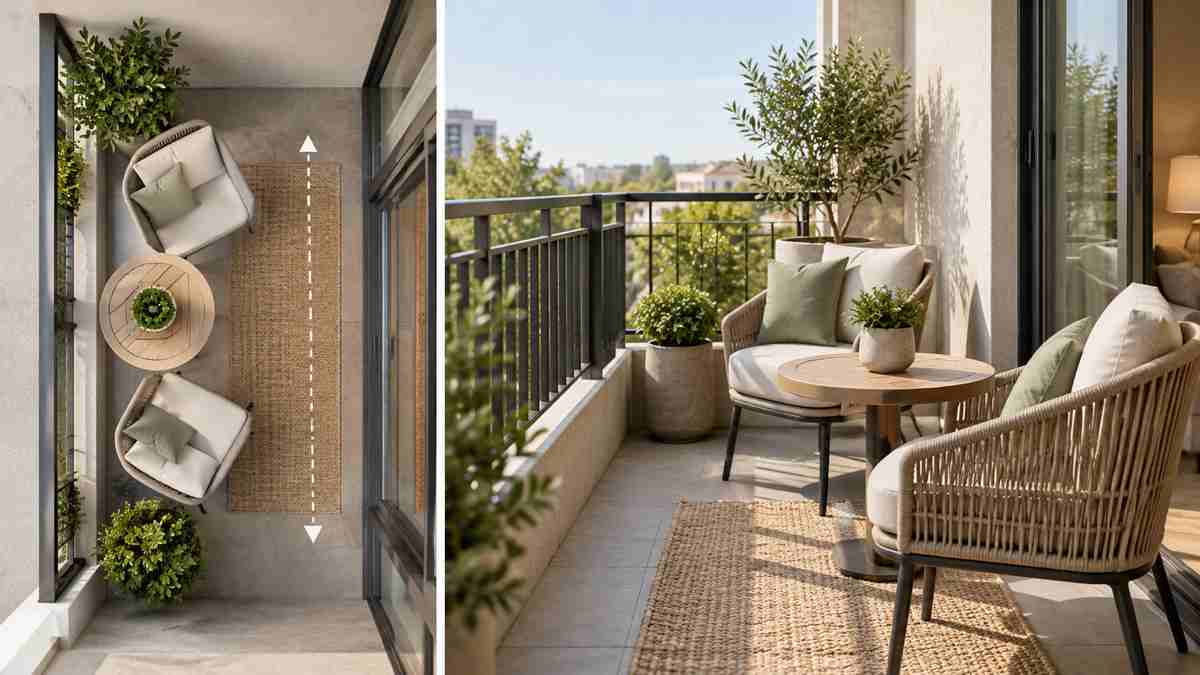
How to Choose Small Space Outdoor Furniture More Effectively
Good small space outdoor furniture should solve several problems at the same time: it needs to fit the available footprint, remain comfortable, preserve circulation, and adapt when the space is used differently throughout the day.
For compact balconies and patios, the number of furniture pieces matters less than how efficiently each piece performs.
Small-patio design guidance from
HGTV
also emphasizes appropriately scaled furniture and flexible solutions for limited outdoor areas.
Prioritize Furniture That Keeps the Layout Open
Visually light frames, raised legs, slim armrests, compact tables, and open woven structures can help prevent a limited outdoor area from feeling crowded.
This is especially useful when selecting small space outdoor furniture for apartment balconies, hotel terraces, urban patios, and smaller café environments.
Layout is equally important.
The Spruce’s small patio seating guide
discusses strategies such as maintaining circulation and arranging seating so limited floor area remains usable.
Think Beyond the Initial Furniture Setup
The best small space outdoor furniture should also remain practical when the space needs to change.
Stackable chairs, nesting tables, lightweight aluminum frames, compact loveseats, and modular pieces can make it easier to move from dining to lounging or recover open floor space when furniture is not required.
For B2B buyers, this flexibility can also create commercial advantages.
A well-designed compact product may support apartment retail collections, guest-room balconies, small hospitality terraces, cafés, and urban residential projects using the same core design language.
Ultimately, successful small space outdoor furniture combines efficient dimensions with real comfort. Reducing size should never mean making a chair uncomfortable, a table impractical, or a layout difficult to use.
Common Small-Space Furniture Mistakes
Even attractive furniture can fail when it is placed in the wrong space.
Common mistakes include:
- Choosing an oversized sofa
- Blocking the balcony door
- Using a table that is too wide
- Leaving no clear walkway
- Adding too many individual pieces
- Choosing deep chairs for a shallow balcony
- Ignoring where furniture will be stored
- Using cushions that require more maintenance than the space allows
The goal of small space outdoor furniture is not to make a tiny patio imitate a large garden.
It is to make the available space feel intentional and comfortable.
What Should B2B Buyers Look for?
For retailers, importers, developers, hotels, and sourcing teams, compact furniture should be evaluated as a specific product category.
Useful questions include:
- What is the total product footprint?
- Can the product stack or nest?
- How much does each piece weigh?
- Is it easy for one person to move?
- Does KD construction reduce packaging volume?
- Can dimensions be adjusted?
- What is the carton CBM?
- Can the collection share colors and materials?
- Is comfort maintained despite smaller dimensions?
A product that occupies less floor area may also improve packaging and container efficiency, but structural stability and comfort should remain part of the development process.
Small-Space Outdoor Furniture Development at Saigon Wicker
Saigon Wicker develops outdoor furniture for international B2B markets using combinations of powder-coated aluminum, steel, outdoor rope, synthetic wicker, wood, Textilene, glass, fabrics, and cushions.
For compact outdoor collections, product development may consider overall footprint, seat dimensions, armrest width, table size, stacking, nesting, modular configurations, and packaging requirements.
Depending on manufacturing feasibility, small space outdoor furniture can also be adapted through frame colors, woven materials, cushions, tabletop finishes, and dimensions to suit different retail or hospitality markets.
Learn more about
Saigon Wicker’s manufacturing capabilities
and our
approach to B2B outdoor furniture development
.
Frequently Asked Questions
What is the best outdoor furniture for a small balcony?
Compact bistro sets, two-seat lounge furniture, stackable chairs, nesting tables, and lightweight pieces are practical options. The best choice depends on the balcony dimensions and intended use.
What is small space outdoor furniture?
Small space outdoor furniture is designed around compact footprints, practical proportions, comfort, and flexibility for balconies, small patios, courtyards, and other limited outdoor areas.
Is a sofa suitable for a small patio?
Yes. A compact two-seat loveseat can work well when the seat depth, frame depth, and circulation space are carefully considered.
Are round tables better for small patios?
Round tables can work well because they reduce sharp corners and may improve circulation in compact spaces, although the best shape depends on the actual layout.
Are stackable chairs good for balconies?
Yes. Stackable chairs can help recover usable floor space when seating is not required and are particularly useful where storage is limited.
What materials work well for compact outdoor furniture?
Powder-coated aluminum, outdoor rope, synthetic wicker, Textilene, wood accents, and outdoor fabrics can all work depending on the product, climate, and maintenance requirements.
Can small outdoor furniture be customized?
Depending on manufacturing feasibility, dimensions, frame colors, rope or wicker, cushion fabrics, tabletops, configurations, and packaging can be adapted for different markets and projects.
Small Outdoor Spaces Need Smarter Furniture, Not More Furniture
The best small space outdoor furniture does not try to fit a full-size patio collection into a smaller area.
It uses proportion, flexibility, and thoughtful materials to make limited space more comfortable and useful.
Measure first. Protect circulation. Choose the right scale. Use stackable, nesting, or multifunctional products where they genuinely solve a problem, and maintain enough comfort for the furniture to be used regularly.
For balconies and compact patios, every piece should earn the space it occupies.
Develop a Compact Outdoor Collection With Saigon Wicker
If you are developing furniture for balconies, apartment patios, guest-room terraces, compact cafés, or other small outdoor spaces, Saigon Wicker can review your product requirements.
Contact Saigon Wicker
and share your drawings, dimensions, reference images, target quantities, material requirements, or project brief.