
A competitive quotation may look attractive at the beginning. However, the right outdoor furniture supplier should also demonstrate clear material specifications, stable manufacturing processes, effective quality control, export-ready packaging, and reliable communication.
Before placing an order, B2B buyers should therefore evaluate not only what a factory can make, but also how consistently an outdoor furniture supplier can manufacture, inspect, pack, and deliver products at commercial scale.
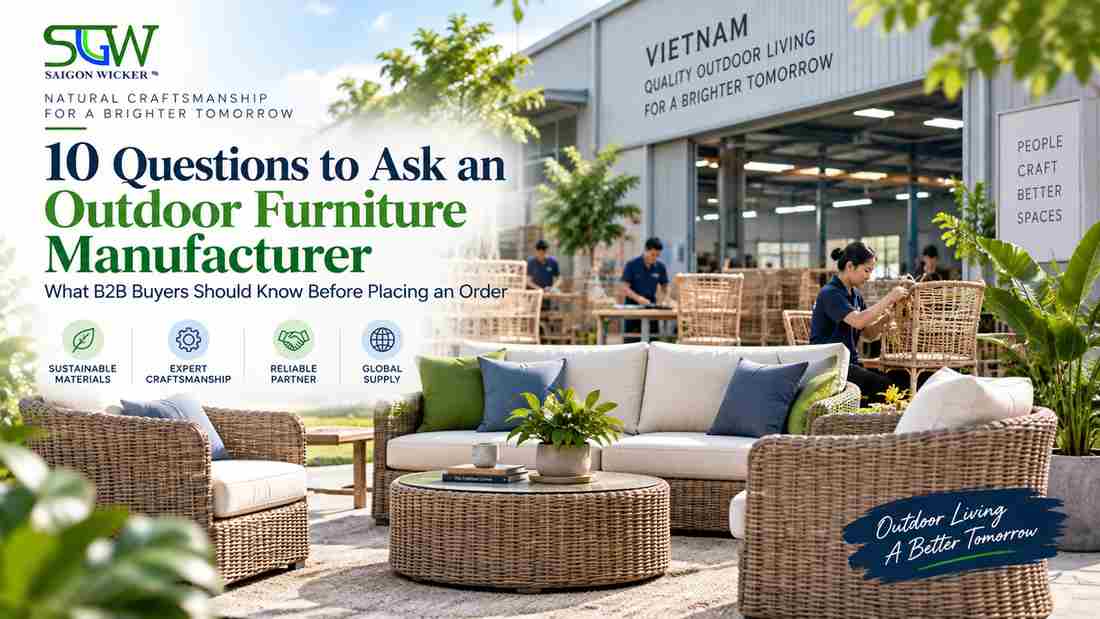
Here are 10 important questions that can help importers, wholesalers, retailers, sourcing companies, and hospitality buyers evaluate an outdoor furniture supplier before confirming an order.
Table of Contents
- What Outdoor Furniture Materials Do You Specialize In?
- Have You Manufactured Similar Outdoor Furniture Before?
- Do You Offer OEM, ODM, and Custom Development?
- What Are Your MOQ, Pricing Structure, and Order Requirements?
- How Does Your Sample Development Process Work?
- What Is Your Production Capacity and Lead Time?
- How Do You Control Outdoor Furniture Quality?
- What Certifications and Documentation Can You Support?
- How Will the Furniture Be Packed and Loaded?
- How Do You Handle Claims and Repeat Orders?
How to Evaluate an Outdoor Furniture Supplier Before Ordering
Choosing an outdoor furniture supplier is not simply a matter of finding attractive products at a competitive price. Buyers should examine materials, manufacturing experience, OEM capabilities, quality systems, production capacity, packaging, export experience, and long-term support.
1. What Outdoor Furniture Materials Do You Specialize In?
Start with materials.
Outdoor furniture is continuously exposed to sunlight, humidity, rain, temperature changes, and repeated use. A manufacturer should therefore understand not only how a material looks, but also how it performs in outdoor environments.
Ask what materials the factory regularly works with, such as aluminum and powder-coated aluminum, steel, outdoor rope, PP or PE wicker, teak, acacia, eucalyptus, tempered glass, outdoor fabrics, textilene, Olefin, polyester, foam, and stainless-steel hardware.
More importantly, ask for the specifications behind those materials.
For an aluminum frame, for example, buyers may need to confirm tube dimensions, wall thickness, welding construction, surface preparation, powder-coating specification, and finish.
For woven products, ask about the type, diameter, structure, color consistency, UV requirements, and weaving construction of the rope or synthetic wicker.
For cushions, confirm the fabric type, fabric weight, foam construction, zipper, stitching, water resistance, UV requirements, and care instructions.
A reliable outdoor furniture supplier should be able to explain material specifications clearly rather than simply describe a product as “outdoor grade.”
Buyer Tip
Always approve material specifications together with the product sample. A beautiful sample is not enough if the bulk order can be produced using materials that differ from the approved standard.
Buyers comparing woven materials can also read our
Outdoor Rope vs PP Rattan guide
to better understand how different materials can influence appearance, performance, and market positioning.
2. Have You Manufactured Similar Outdoor Furniture Before?
Experience with outdoor furniture matters.
A factory that can manufacture indoor furniture is not automatically the right factory for outdoor products.
Outdoor furniture requires attention to drainage, corrosion resistance, UV exposure, weather-resistant finishes, cushion performance, structural stability, and long-term outdoor use.
Ask the manufacturer to show examples of products similar to your project.
If you are developing an aluminum rope sofa set, for example, ask whether the factory regularly produces aluminum frames, rope weaving, outdoor cushions, and matching tables.
If you are sourcing furniture for hotels or resorts, ask about previous experience with commercial or hospitality projects where products may receive more frequent use than typical residential furniture.
An experienced outdoor furniture supplier should already understand the materials, engineering, production processes, and quality expectations required for your type of product.
3. Do You Offer OEM, ODM, and Custom Outdoor Furniture Development?
For many B2B buyers, customization is one of the most important factors when choosing a manufacturing partner.
Ask whether the manufacturer provides OEM outdoor furniture, ODM development, private-label production, or modifications to existing collections.
Depending on the project, customization may include dimensions, frame colors, powder-coating finishes, rope colors, wicker colors, fabric selections, cushion construction, wood finishes, tabletop materials, packaging, labels, logos, and carton markings.
For full OEM development, ask how the factory handles the process from the initial idea to production.
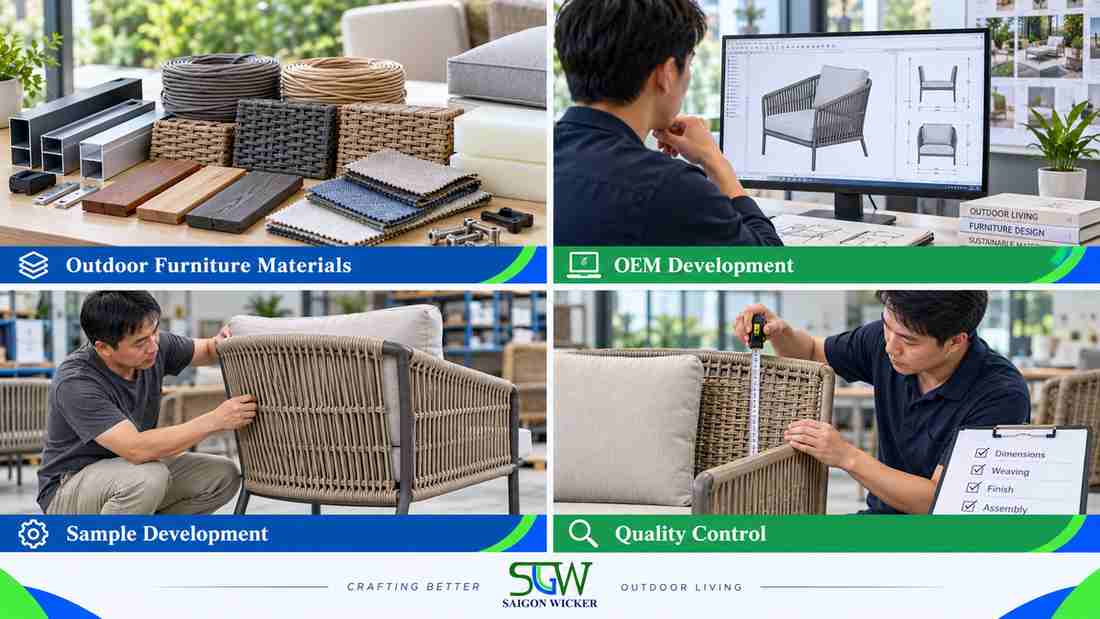
A professional development workflow should move through clearly defined stages such as concept evaluation, technical drawings, material selection, prototype development, sample review, revisions, sample approval, and mass production.
Also clarify who controls technical changes.
A product can look correct visually while small changes to dimensions, frame construction, cushion thickness, or materials can significantly affect comfort, appearance, packaging, and cost.
For customized collections, the right outdoor furniture supplier should act as a technical development partner throughout the OEM or ODM process rather than simply follow incomplete instructions.
4. What Are Your MOQ, Pricing Structure, and Order Requirements?
Minimum order quantity, or MOQ, should be discussed early.
MOQ can vary according to product type, material, color, customization level, packaging, and whether components can be shared across several SKUs.
Ask whether MOQ applies per item, per color, per collection, or per order.
This becomes especially important when launching a new collection with several products.
For example, a buyer may want one sofa, two armchairs, a coffee table, and a dining set in the same finish. Understanding whether materials and colors can be combined across different SKUs can help buyers plan their first order more efficiently.
A professional outdoor furniture supplier should clearly explain MOQ requirements, pricing structure, and conditions for mixed-SKU orders.
Price should also be evaluated together with specification.
When comparing quotations from several factories, confirm that each quotation is based on the same frame construction, materials, fabrics, hardware, finishing, packaging, and testing requirements.
A lower unit price does not necessarily mean a lower total sourcing cost.
Packaging volume, defect rates, replacement claims, assembly problems, delays, and inconsistent repeat orders can quickly eliminate the initial saving.
For B2B sourcing, consistency and total landed value matter more than the lowest quotation alone.
5. How Does Your Sample Development and Approval Process Work?
Never underestimate the sample stage.
The production sample creates the physical reference for the final order and allows both the buyer and the outdoor furniture supplier to confirm important details before mass production.
Ask how long sample development normally takes and what information the manufacturer needs before starting.
The sample review should cover dimensions, proportions, frame construction, materials, colors, finish, weaving pattern, tabletop construction, cushion thickness, stitching, comfort, stability, hardware, and assembly.
For customized products, buyers should also confirm how revisions are recorded.
Whenever possible, keep an approved specification sheet together with technical drawings, finish references, fabric references, photographs, and the final approved sample.
This creates a common reference between the buyer, sales team, technical department, production team, and quality control team.
Bulk production should reproduce the approved product consistently—not reinterpret it.
6. What Is Your Production Capacity and Typical Lead Time?
A manufacturer may produce an excellent sample but still struggle to deliver a large order on time.
Production capacity is another important factor when evaluating an outdoor furniture supplier for long-term cooperation.
Ask about typical monthly production capability, production planning, peak-season capacity, and the normal lead time after sample and order approval.
You should also understand which production processes are handled internally and which are outsourced.
For outdoor furniture, the workflow may involve material preparation, tube cutting, bending, welding, grinding, powder coating, weaving, woodworking, sewing, cushion production, assembly, inspection, packing, and container loading.
Understanding this process helps buyers identify possible bottlenecks.
A reliable manufacturing partner should communicate quickly if a material, component, schedule, or technical issue may affect delivery.
For seasonal outdoor furniture programs, production timing can influence an entire selling season. Lead time should therefore be evaluated with the same attention as price.
Learn more about
Saigon Wicker’s manufacturing background and capabilities
.
7. How Do You Control Outdoor Furniture Quality?
This may be one of the most important questions in the entire sourcing process.
Quality control should not happen only after the product is finished.
A dependable outdoor furniture supplier should integrate quality control throughout production rather than relying only on final inspection.
A strong outdoor furniture quality control system should identify problems as early as possible during manufacturing.
Buyers should ask how the factory checks incoming materials, frame construction, welding, surfaces, powder coating, weaving, wood components, cushions, dimensions, assembly, stability, appearance, packaging, and final products.
The approved sample and specification should serve as the quality reference.
For metal furniture, buyers may want to inspect welding consistency, frame alignment, finish quality, scratches, coating coverage, hardware, and structural stability.
For woven products, QC may include weaving tension, spacing, finishing points, color consistency, and overall appearance.
For cushions, important areas include dimensions, fabric direction, stitching, filling, zipper construction, shape, and fit on the furniture.
Quality control is most effective when it prevents defects rather than simply discovers them at the end of production.
8. What Certifications, Compliance, and Documentation Can You Support?
Different buyers and markets may require different levels of compliance.
Before confirming an order, ask what certifications, audits, material documentation, testing support, and traceability the manufacturer can provide.
An export-oriented outdoor furniture supplier should understand documentation, testing, traceability, and compliance requirements for different markets.
For responsibly sourced wood products, buyers can review standards and certification information published by the
Forest Stewardship Council (FSC)
.
For textile-related requirements, buyers can also review testing and certification information provided by
OEKO-TEX
.
Requirements may relate to responsible manufacturing, timber sourcing, textiles, restricted substances, packaging, labeling, product testing, or individual retailer standards.
Do not assume that every certification applies automatically to every product.
Instead, define the destination market and specific compliance requirements before production.
For wood products, buyers may need documentation related to species and responsible sourcing.
For textiles, fabric specifications and applicable testing may be required.
Retailers and hospitality buyers may also have their own inspection protocols, packaging requirements, labeling standards, and testing procedures.
A manufacturer experienced with international B2B customers should be able to discuss these requirements early and identify what documentation can be supplied for the project.
9. How Will the Furniture Be Packed and Loaded for Export?
Packaging is part of product engineering.
Outdoor furniture can travel thousands of kilometers before reaching a distributor, retailer, hotel, or final customer. A product that leaves the factory in perfect condition can still arrive damaged if the packaging is poorly designed.
Ask the manufacturer how frames, corners, legs, tabletops, glass, wood surfaces, cushions, and hardware will be protected.
For knock-down furniture, confirm the assembly instructions and hardware packaging as well.
A good outdoor furniture supplier considers packaging and container efficiency as part of the complete product-development process.

B2B buyers should also consider packed dimensions and CBM.
Furniture is bulky, which means container utilization can significantly influence landed cost.
A slightly more efficient KD structure or carton configuration can allow more units to fit into a 40HC container and reduce freight cost per product.
Before final order confirmation, consider requesting carton dimensions, gross weight, net weight, CBM, packing method, and estimated container loading quantity.
A good outdoor furniture supplier for export should think about the complete journey of the product—not just the moment it leaves the production line.
10. How Do You Handle Claims, Replacement Parts, and Repeat Orders?
The first shipment is only the beginning of a good B2B manufacturing relationship.
Ask what happens if a component is missing, a product is damaged, or a quality issue appears after delivery.
Does the manufacturer have a clear claims process?
Can it provide replacement hardware, cushions, components, or spare parts?
How will the factory maintain the same frame color, rope color, fabric, construction, and specifications for future repeat orders?
Long-term buyers should choose an outdoor furniture supplier capable of supporting repeat orders, replacement parts, and consistent specifications.
These questions become especially important for retailers, distributors, hotels, resorts, and brands planning long-term collections.
Consistency between the first sample, first shipment, and future repeat orders is one of the clearest signs of a reliable manufacturing partner.
The best supplier relationship is not one that completes a single purchase order successfully.
It is one that can support the buyer as the business grows.
5 Bonus Questions Serious B2B Buyers Should Ask
Can I Visit or Audit Your Factory?
Factory visits can provide valuable insight into manufacturing processes, organization, quality control, warehouse conditions, materials, and actual production capability.
Which Production Processes Are Managed In-House?
Understanding which processes are internal and which are performed by external partners helps clarify responsibility, lead times, and quality control.
Can You Support Mixed-SKU Container Orders?
This is particularly useful for wholesalers and retailers building collections across sofa sets, dining sets, coffee sets, sun loungers, and other categories.
Can You Help Optimize Products for KD Packing and Container Loading?
A manufacturer with product engineering and export experience may be able to improve packing efficiency without compromising design or structural performance.
How Do You Maintain Consistency Across Repeat Orders?
Ask how approved colors, fabrics, specifications, technical drawings, materials, and product records are controlled for future orders.
What Should Buyers Prepare Before Contacting an Outdoor Furniture Supplier?
Manufacturers can provide more accurate quotations when buyers provide clear information from the beginning.
A useful RFQ should explain the product type, estimated quantity, dimensions, materials, target colors or finishes, cushion and fabric requirements, target market, packaging requirements, expected delivery schedule, customization requirements, and available drawings or reference images.
The more complete the specification, the easier it becomes for the outdoor furniture supplier to evaluate feasibility and provide meaningful pricing.
Instead of asking only:
“Can you quote this chair?”
A better sourcing request defines exactly what the buyer expects the factory to manufacture.
That reduces misunderstandings during sampling and creates a stronger foundation for production.
Choosing the Right Outdoor Furniture Supplier Is About More Than Price
Selecting the right outdoor furniture supplier should be treated as a long-term sourcing decision rather than a simple price comparison.
Materials, engineering, OEM capabilities, MOQ, sample development, production capacity, quality control, compliance, packaging, export experience, and after-sales support can all influence the final commercial result.
A dependable outdoor furniture supplier should be able to reproduce approved products consistently, communicate clearly, and support buyers throughout development, production, and shipment.
Asking these questions before placing an order allows buyers to compare manufacturers on more than unit price.
For importers, wholesalers, retailers, sourcing companies, and hospitality buyers, the objective should not simply be finding the lowest-cost factory.
The objective is to build a reliable partnership with an outdoor furniture supplier capable of delivering the right product, at the right quality, for the right market.
For buyers evaluating long-term manufacturing partners, explore
why international B2B buyers work with Saigon Wicker
.
Why Work With Saigon Wicker?
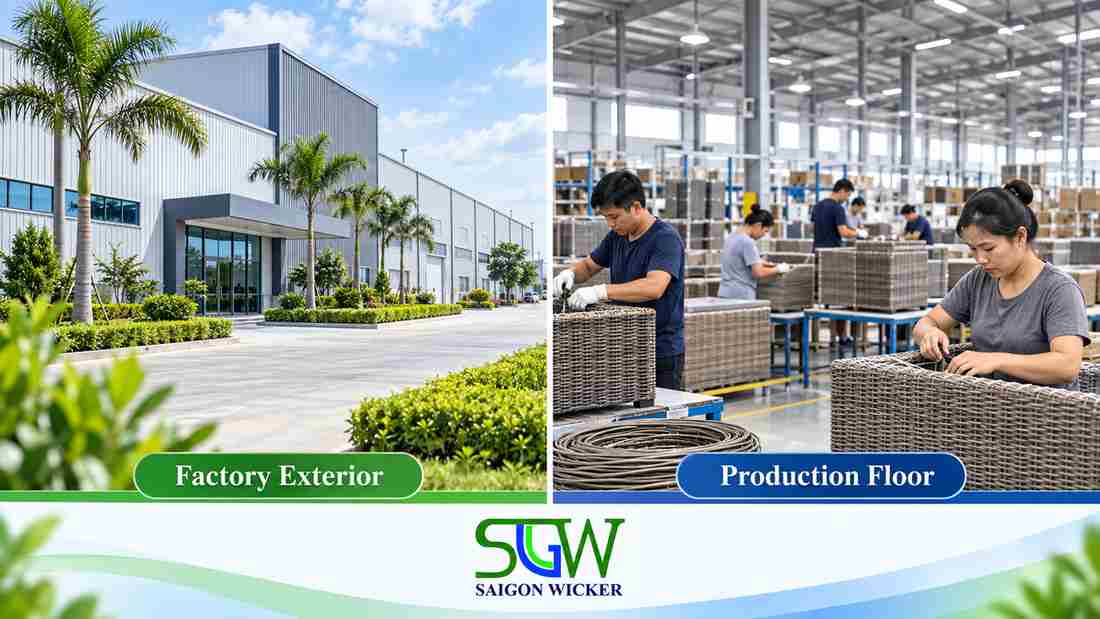
Saigon Wicker is an outdoor furniture supplier and manufacturer in Vietnam serving international B2B markets.
Our manufacturing capabilities cover combinations of aluminum, steel, outdoor wicker, rope, wood, glass, outdoor fabrics, and cushions.
We support product development based on customer drawings, reference images, specifications, and project requirements, making it possible to develop both customized products and market-specific collections.
From material preparation and manufacturing to quality control, packaging, and container loading, our goal is to create a transparent and reliable production process for every project.
For buyers looking for an OEM outdoor furniture manufacturer in Vietnam, the conversation should begin with the product, target market, and commercial requirements behind it.
Share your drawings, reference images, specifications, target quantities, or product ideas with the Saigon Wicker team to discuss your next outdoor furniture project.
Ready to discuss a new collection?
Contact Saigon Wicker
and send us your drawings, reference images, specifications, or target quantities.
Frequently Asked Questions
What should I ask an outdoor furniture supplier before ordering?
Buyers should ask about materials, previous manufacturing experience, OEM/ODM capability, MOQ, sample development, production capacity, lead time, quality control, certifications, packaging, export support, and after-sales service.
How do I choose a reliable outdoor furniture supplier?
Look beyond price. Evaluate whether the supplier has experience with your product category, understands outdoor materials, has clear quality-control procedures, can reproduce approved samples consistently, and can support your required order volume and export market.
What is the MOQ for outdoor furniture?
MOQ varies according to the manufacturer, product type, material, color, packaging, and level of customization. Buyers should confirm whether MOQ is calculated per SKU, finish, collection, or total order before beginning development.
Should I order a sample before mass production?
Yes. For B2B and customized outdoor furniture, an approved sample helps establish the reference for dimensions, construction, materials, colors, finishing, comfort, packaging, and overall quality before bulk production begins.
What is OEM outdoor furniture manufacturing?
OEM outdoor furniture manufacturing generally means producing furniture based on a buyer’s design, drawings, specifications, or technical requirements. It allows brands, importers, and retailers to develop products tailored to their market.
Why source outdoor furniture from Vietnam?
Vietnam has an established export-oriented furniture manufacturing industry and access to a wide range of furniture materials and production capabilities.
The most important factor is selecting an outdoor furniture supplier whose experience, quality systems, materials, production capacity, and export capabilities match the specific project.
What information should I send when requesting an outdoor furniture quotation?
Provide product images or technical drawings, dimensions, materials, colors, finishes, estimated quantities, cushion specifications, packaging requirements, destination market, customization requirements, and target delivery schedule whenever available.
Final Buyer Checklist
Before confirming your purchase order, make sure the product specification, approved sample, materials, colors, construction, MOQ, price, production lead time, QC requirements, packaging, carton information, testing or compliance requirements, shipping terms, and final inspection process are clearly agreed by both parties.
A clear order at the beginning is one of the best ways to achieve a consistent shipment at the end.